

Step 1
Requirements Analysis
Our services deliver measurable results
We use AI across planning, design, and development to reduce waste, speed up delivery, and improve quality, without increasing budgets.

We joined at the idea stage and supported the project from workflow analysis through system deployment and internal distribution.
Companies building operational platforms for managing physical assets with mobile execution, offline capability, and real time status tracking.
 Product Design
 Laravel
 Flutter Apps
 239
Views
239
Views

Yunus-Emre Akarca
CEO
fame-tec is a fluid management company responsible for maintaining liquid conditions in on site industrial machines.
Manual processes made it difficult to track machine status, detect issues early, and document maintenance reliably.
The idea was to replace paper based workflows with an automated digital solution that allows employees to access machine data instantly, update fluid values on site, and give customers transparency into the condition of their machines.
Reducing manual effort, preventing errors, and improving operational control were the core motivations behind the project.
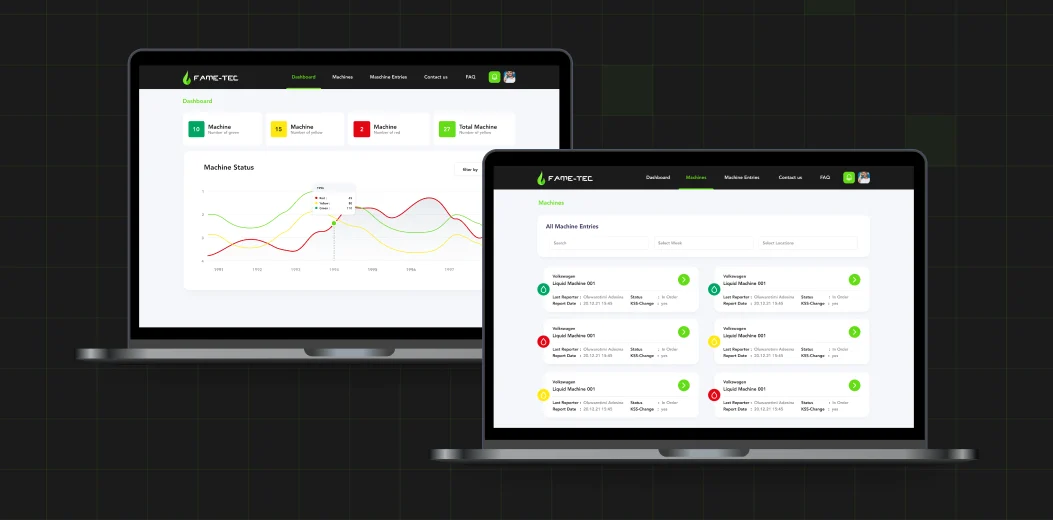
We built a comprehensive IT solution consisting of a mobile app, web app, and admin panel.
Machines are registered in the system and assigned QR codes that link directly to their digital records.
Employees use the mobile app to scan machines, view liquid history, and update status values on site, even offline.
Customers access a dedicated panel to monitor their machines, while automated reports and status indicators provide continuous visibility and control across the entire system.
Step 1
Requirements Analysis
Step 2
Concept and Design
Step 3
Implementation
Step 4
Quality Assurance
Step 5
Internal Distribution
Each machine is assigned a unique QR code generated in the admin panel and attached to the production line.
Employees scan the code using the mobile app to access machine details, liquid history, target values, and contact information instantly.
This removes manual searching and ensures accurate identification on site.
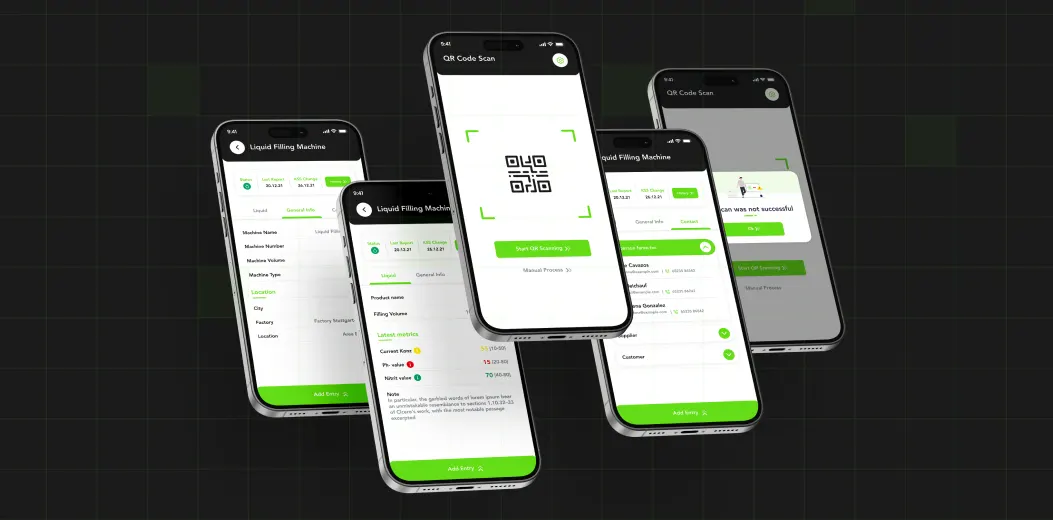
The system tracks liquid values and compares them against predefined target ranges.
A clear color coded status system indicates whether values are acceptable, tolerable, or require action.
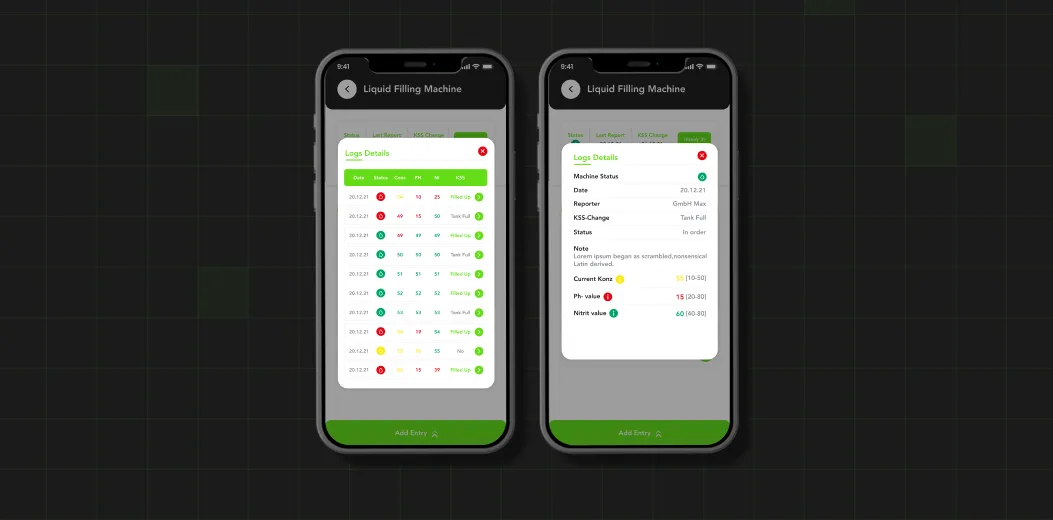
Employees and customers can review current status, historical entries, and timestamps at any time.
The mobile app supports full offline usage.
Assigned machines and recent data are stored locally, allowing employees to search machines, review details, and add status reports without connectivity.
Entries are synchronized automatically once the device reconnects, ensuring no data is lost.
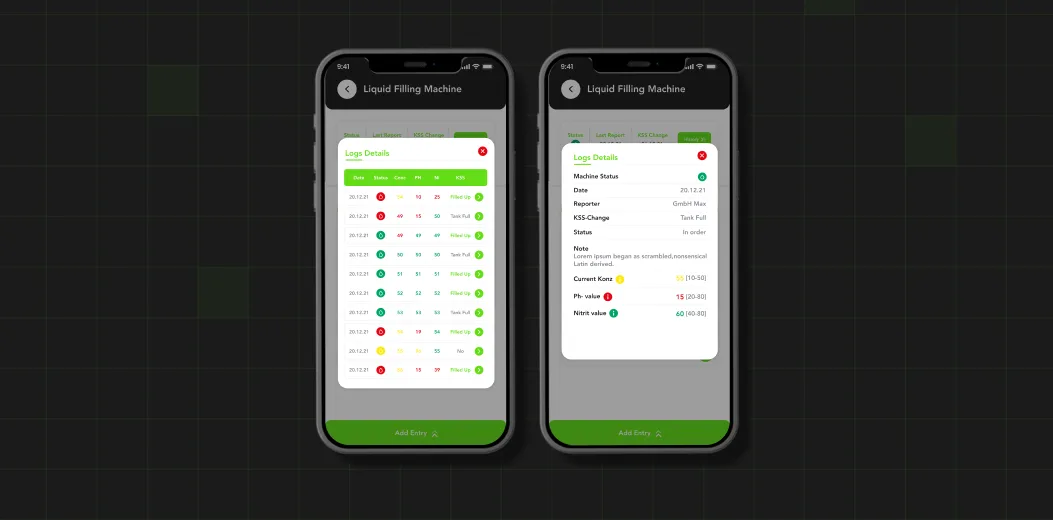
Employees can manually enter and adjust liquid values, notes, and observations.
The system prevents incomplete submissions and allows review of previous entries.
This ensures consistent documentation even in exceptional situations.
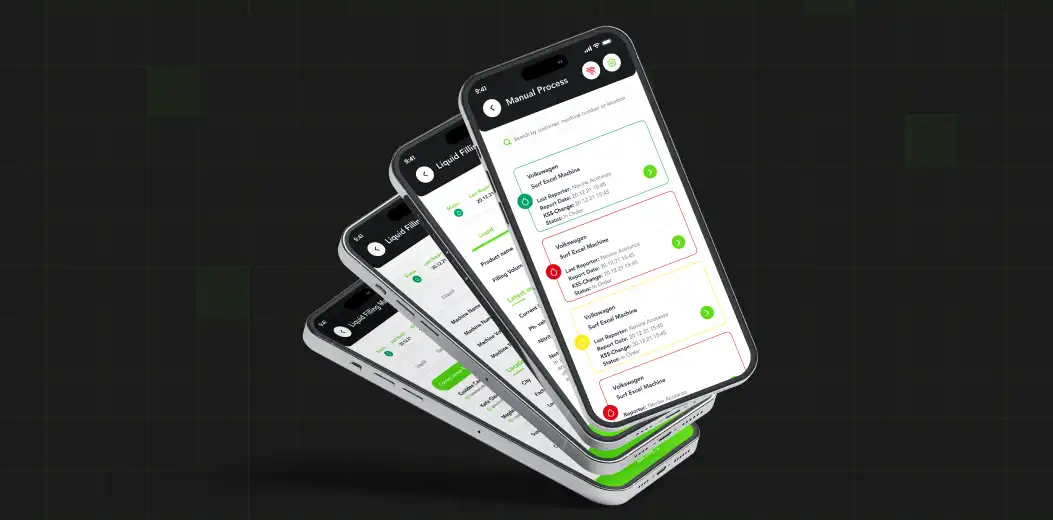
Machine owners access a dedicated customer panel to monitor all machines, view status indicators, and export reports as PDFs.
Automated email summaries are sent daily, keeping customers informed without manual effort.
The biggest challenge was designing a reliable offline workflow for environments where internet access is often unavailable.
Employees needed to continue working without interruption while ensuring data accuracy and consistency.
We designed a solution that downloads relevant machine data to the device, stores new entries locally, and synchronizes them safely once connectivity is restored.
Keeping this process simple and error proof was critical to avoid missing or conflicting updates.
We learned that offline first design requires clear data ownership and synchronization rules.
Simplicity in user flows prevents costly errors in operational environments.
These learnings help partners build systems that work reliably in real world conditions. They reduce operational risk and ensure continuity even when infrastructure is limited.
If your product is used in environments with limited connectivity, design offline workflows as a core feature, not an exception. Reliability drives adoption.
The most special part of this project was designing and implementing a truly offline capable operational system.
Employees can continue scanning machines, reviewing data, and entering liquid values without worrying about connectivity.
Local storage, synchronization logic, and clear user feedback ensure that no data is lost and no steps are missed.
This capability transformed the solution from a digital tool into a reliable everyday companion for on site work, showing how thoughtful offline design can fundamentally improve operational efficiency and trust.
 Yunus-Emre Akarca
CEO
5.0
Yunus-Emre Akarca
CEO
5.0
The solution replaced manual maintenance tracking with a digital, easy-to-use system. Reports can now be created and shared instantly, improving transparency for customers. Delivery was structured, and the collaboration felt dependable throughout.
Every successful project leaves behind measurable results and a clear path forward.
The references below show how we work, what we deliver, and the outcomes our partners achieve with us.
 STRATEGY
 UI/UX
UI/UX
 SAAS
SAAS
 WEB DEVELOPMENT
PCapital - How a Cybersecurity Expert Became a Software Company
WEB DEVELOPMENT
PCapital - How a Cybersecurity Expert Became a Software Company
 Karoly Aczel
Founder & CEO, Perpetuum Capital Ltd.
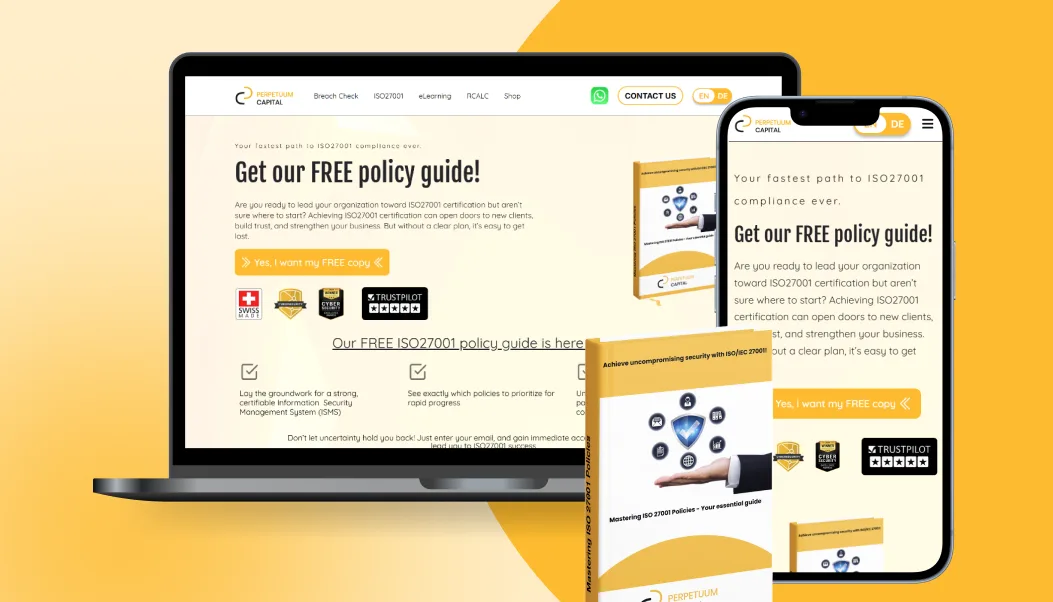
The founding team had years of hands-on ISO 27001 consulting experience and knew exactly what companies needed to get certified - but everything was delivered manually, one client at a time. The gap was clear: companies wanting ISO 27001 certification were either paying expensive consultants for work that could be structured into a guided tool, or they were lost in documentation without any support. The idea was to build two things that work together: a professional website that builds trust and sells digital products, and a SaaS application called Sentinel that guides organizations through ISO 27001 certification and ongoing ISMS management without needing a consultant in the room.
One-person consultancy → platform business
Use case
Karoly Aczel
Founder & CEO, Perpetuum Capital Ltd.
The founding team had years of hands-on ISO 27001 consulting experience and knew exactly what companies needed to get certified - but everything was delivered manually, one client at a time. The gap was clear: companies wanting ISO 27001 certification were either paying expensive consultants for work that could be structured into a guided tool, or they were lost in documentation without any support. The idea was to build two things that work together: a professional website that builds trust and sells digital products, and a SaaS application called Sentinel that guides organizations through ISO 27001 certification and ongoing ISMS management without needing a consultant in the room.
One-person consultancy → platform business
Use case
 STRATEGY
UI/UX
STRATEGY
UI/UX
 MARKETPLACE
OfficeActor - End-to-End Influencer Booking Platform
Marlon B.
Founder & CEO, OfficeActor
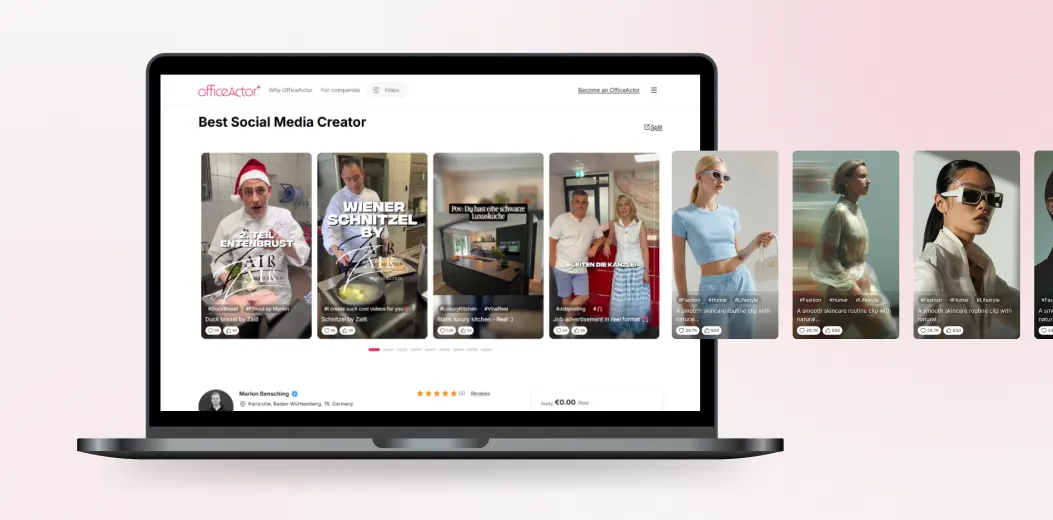
Marlon B. saw a clear gap in the market: companies wanting to collaborate with influencers had no structured way to find, evaluate, and book them. Everything happened through DMs, spreadsheets, and informal agreements. At the same time, influencers had no professional tool to manage incoming requests, track contracts, or get paid reliably. The idea was to build a two-sided platform that gives both parties a clean, structured workflow - from discovery to signed contract to payment.
0 manual booking steps
Use case
MARKETPLACE
OfficeActor - End-to-End Influencer Booking Platform
Marlon B.
Founder & CEO, OfficeActor
Marlon B. saw a clear gap in the market: companies wanting to collaborate with influencers had no structured way to find, evaluate, and book them. Everything happened through DMs, spreadsheets, and informal agreements. At the same time, influencers had no professional tool to manage incoming requests, track contracts, or get paid reliably. The idea was to build a two-sided platform that gives both parties a clean, structured workflow - from discovery to signed contract to payment.
0 manual booking steps
Use case





 Behance


