Step 1
Requirements Analysis
We joined at the very beginning of the project, supporting the idea from its initial concept through to market launch.
Startups and founders who want to build digital products with customized algorithms, structured planning logic, and subscription based models.
 Product Design
 Laravel
 0
Likes
0
Likes
 14
Views
14
Views


We help you make the right product decisions before building.
Meal planning for families is often a demanding responsibility, especially for mothers who must balance allergies, dietary preferences, shared meals, leftovers, and limited time. What should support healthy living quickly becomes a daily source of stress. At the same time, balanced nutrition is essential for well-being and productivity, making this challenge impossible to ignore.
Our partner's idea was to ease this burden by creating a smart meal planner that supports families in organizing their weekly meals in a realistic and structured way. Through an individual and detailed configuration, the system considers the needs of each family member while significantly reducing daily cooking effort. The goal was to enable healthy, varied nutrition without turning food planning into a constant mental load.
Realizing this idea required deep nutritional expertise, real experience as a mother, and the ability to translate both into a simple and intuitive digital solution. Together with our partner, we combined domain knowledge and technical responsibility to transform an initial vision into a reliable and high quality product that genuinely supports families in their everyday routines.
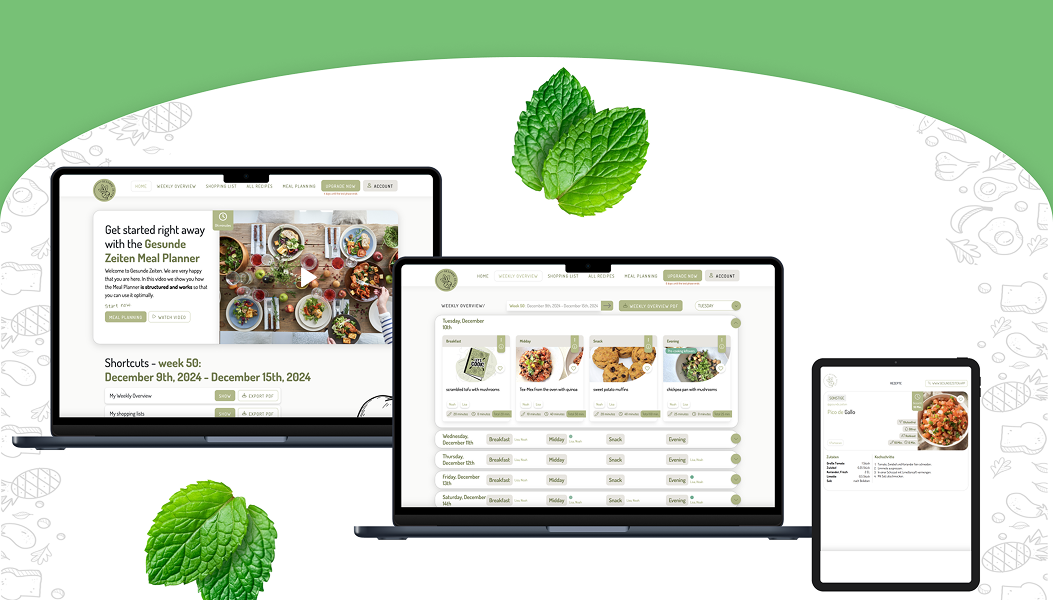
We translated the idea into a structured web based product that combines nutritional expertise with technical logic.
At the core is a configurable system that captures family composition, habits, and preferences, and transforms them into personalized weekly meal plans.
The platform connects user profiles, recipes, planning logic, shopping lists, and subscriptions into one coherent system that supports both daily use and long term scalability.
Step 1
Requirements Analysis
Step 2
UX and Design Concept
Step 3
Implementation
Step 4
Quality Assurance
Step 5
Deployment


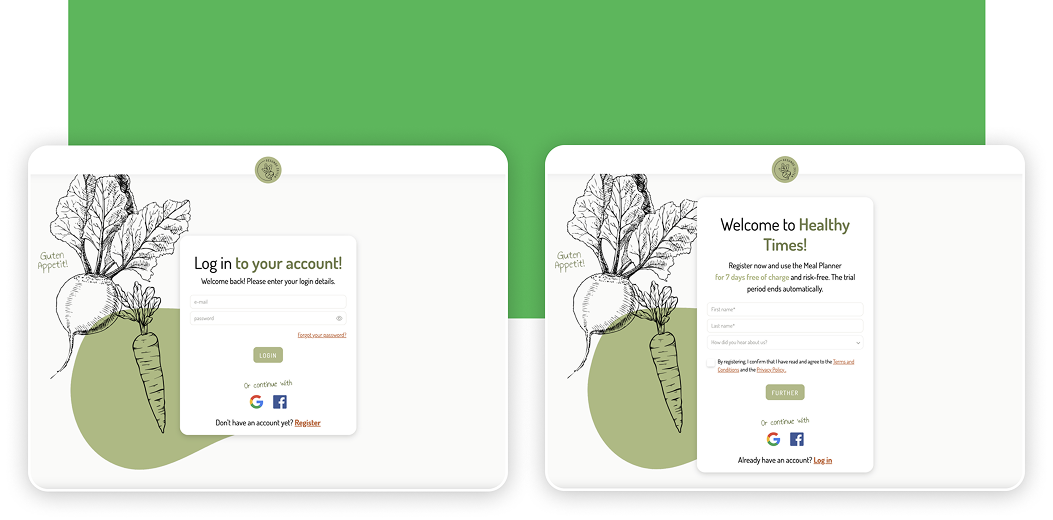
The platform provides a secure onboarding process based on email registration and verification, ensuring that every account belongs to a real and reachable user.
This foundation is especially important for a subscription based product that users integrate into their daily routines.
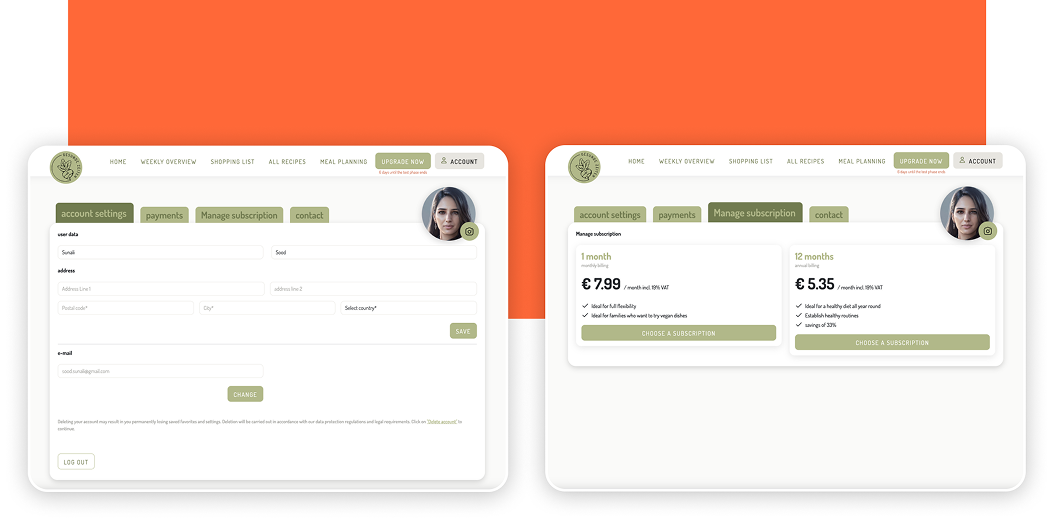
Within the web app, users can manage their personal profile, household information, and all data that directly influences meal planning results. Subscription status, trial periods, payment information, and cancellation options are clearly accessible at all times.
This transparency reduces friction, builds trust, and gives families full control over their account without hidden dependencies.
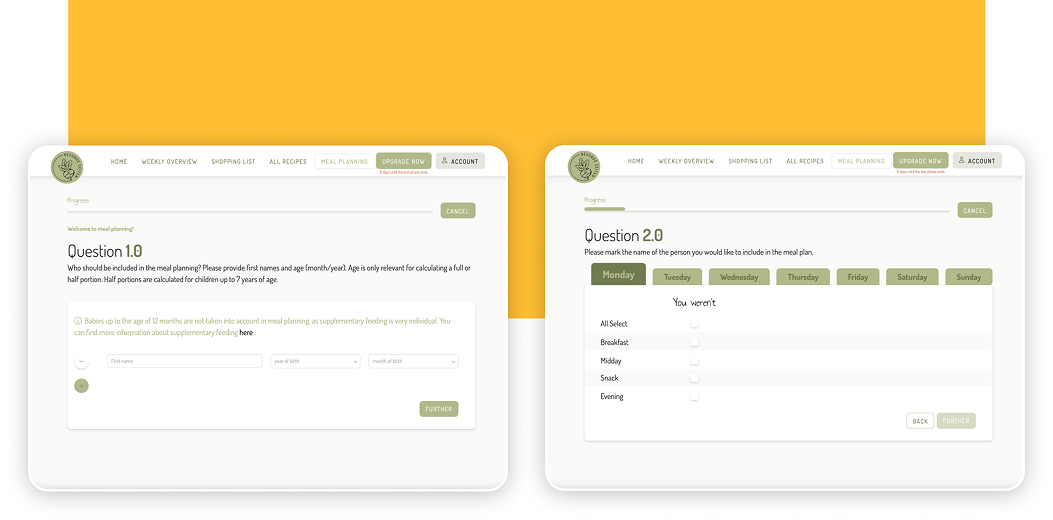
The configurator is the heart of the product and the key differentiator of the platform. It guides users through a structured setup that captures all relevant aspects of family meal planning, including family composition, dietary preferences, allergies, cooking habits, and rules around leftovers or ingredient reuse.
Rather than producing static results, the configurator feeds a custom logic that evaluates how meals can be combined efficiently while still ensuring balanced and varied nutrition.
The setup is intentionally flexible. Users can revisit and adjust their configuration at any time, allowing the system to adapt to changing family situations without breaking existing plans or forcing a complete restart.
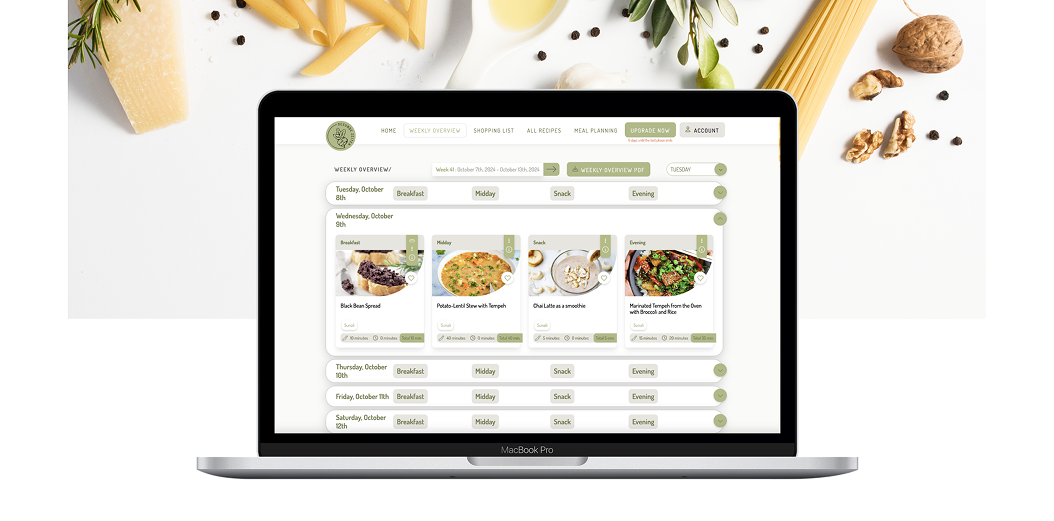
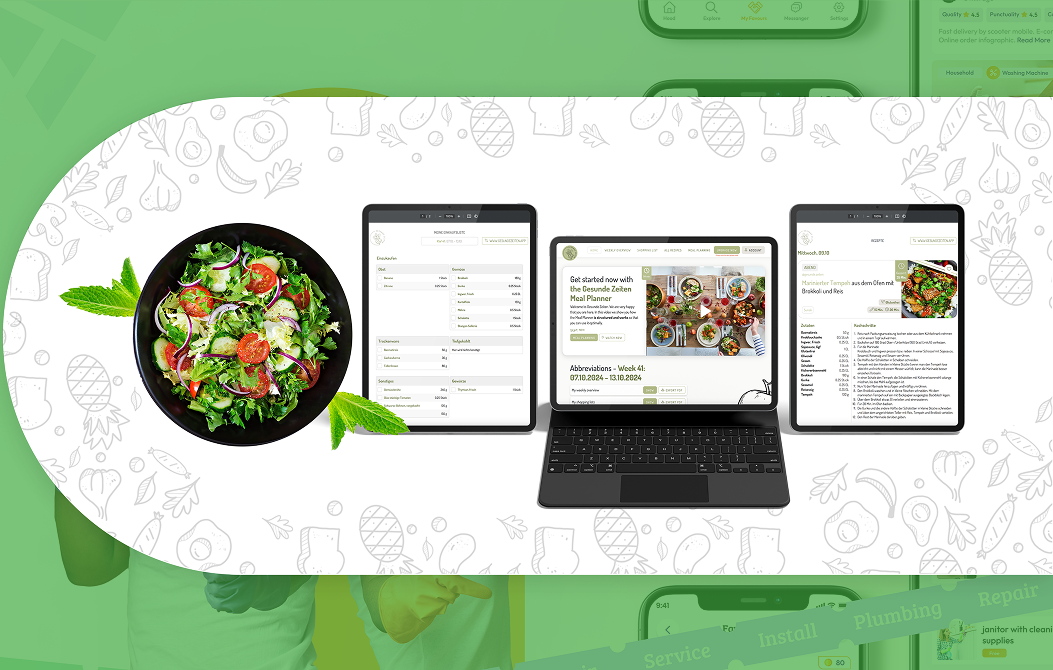
Based on the configurator, the system generates structured meal plans that are presented in a clear weekly overview. Each meal can be explored in detail, including preparation guidance and contextual information that supports realistic cooking decisions.
The platform treats past, current, and future days differently to reflect real life usage. Past meals remain stable, while future meals stay fully adjustable.
Users can replace individual meals, adjust quantities, or add meals from the recipe database without rebuilding the entire plan.
For offline use, complete weekly plans can be exported as a well designed PDF that families can print or display at home.
To support execution beyond planning, the platform automatically generates shopping lists based on the selected days or weeks.
Ingredients are aggregated across meals and structured in a way that reflects real shopping behavior, separating everyday stock items from fresh or perishable goods.
This approach helps users shop faster, avoid unnecessary purchases, and ensure that nothing is forgotten. Shopping lists can be downloaded and used directly during shopping, turning the meal plan into immediate, practical action.
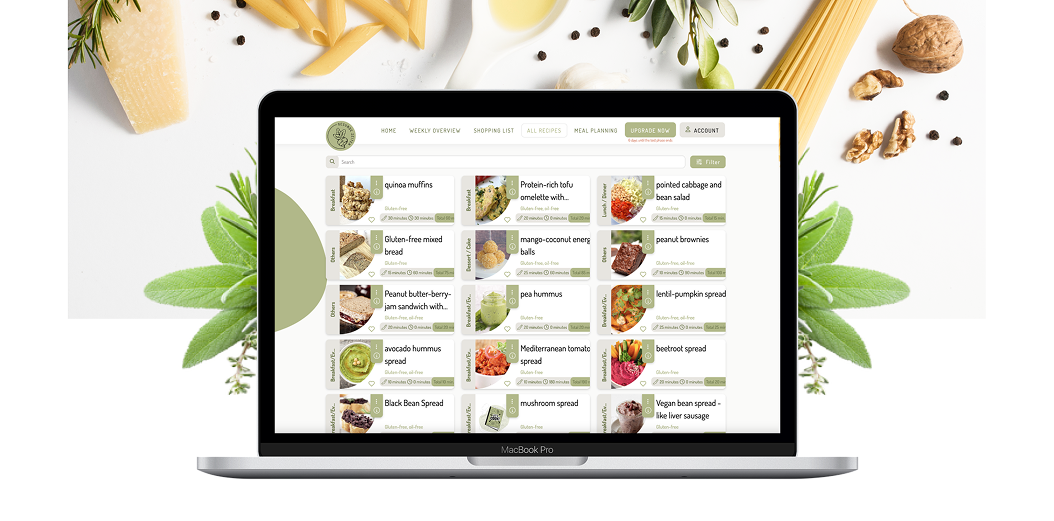
The product follows a simple and transparent subscription model. New users receive a free trial with access to all core features, allowing them to experience the full value of the platform before committing.
After the trial period, users can choose between monthly or yearly memberships. Payments, recurring billing, and cancellations are handled via Stripe and are tightly integrated with account management.
This ensures consistent access rights, clear communication, and a reliable experience throughout the subscription lifecycle.
The central challenge of this project was defining and implementing the logic behind the meal planning algorithm in a way that reflects real family life. Meal planning is not a linear or static problem.
It depends on changing household constellations, dietary rules, allergies, leftovers, shared ingredients, and the difference between past and future meals. All of these factors had to interact without producing rigid or unrealistic results.
At the same time, the logic needed to remain understandable and adjustable for users, not hidden behind opaque automation.
We had to carefully define parameters, structure recipe data correctly, and design database access in a way that allowed flexibility without performance loss. Every decision affected multiple downstream outcomes, making correctness and responsibility critical.
We learned that complex planning logic must be built step by step and validated continuously with real scenarios.
Assumptions break quickly when users are allowed to change configurations at any time. Clear data models and explicit rules are essential to keep systems adaptable without becoming fragile or unpredictable.
These insights help us build products with complex decision logic that remain stable as requirements grow. Partners benefit from solutions that can evolve over time without constant rewrites, reducing long term risk while maintaining user trust and system clarity.

If your product depends on complex decision logic, define parameters and data models early. This creates clarity, reduces rework, and makes scaling predictable.
What made this project special was the responsibility behind building the meal planning logic. The system had to reflect real family life, not idealized nutrition models.
Every rule influenced how families plan, cook, and manage daily routines.
We translated nutritional expertise and lived experience as a mother into logic that feels supportive, flexible, and realistic. There was no blueprint to follow.
This required close collaboration, repeated validation, and a mindset focused on long term usefulness rather than feature completeness.
Explore our online portfolios to see a diverse range of our creative work. From innovative designs to impactful projects, discover how we bring ideas to life!


Experience our mobile app firsthand! Download it from the Play Store and explore its features.

Experience our mobile app firsthand! Download it from the Play Store and explore its features.

Check out the live website that complements our app and see the design and functionality in action.
Experience our mobile app firsthand! Download it from the Play Store and explore its features.
Experience our mobile app firsthand! Download it from the Play Store and explore its features.
Check out the live website that complements our app and see the design and functionality in action.

As a first-time founder, I needed guidance as much as execution. The collaboration helped me visualize, refine, and finally build a highly personalized meal-planning app from scratch. Changes were handled flexibly, communication stayed open, and deadlines were respected.
Every successful project leaves behind measurable results and a clear path forward.
The references below show how we work, what we deliver, and the outcomes our partners achieve with us.
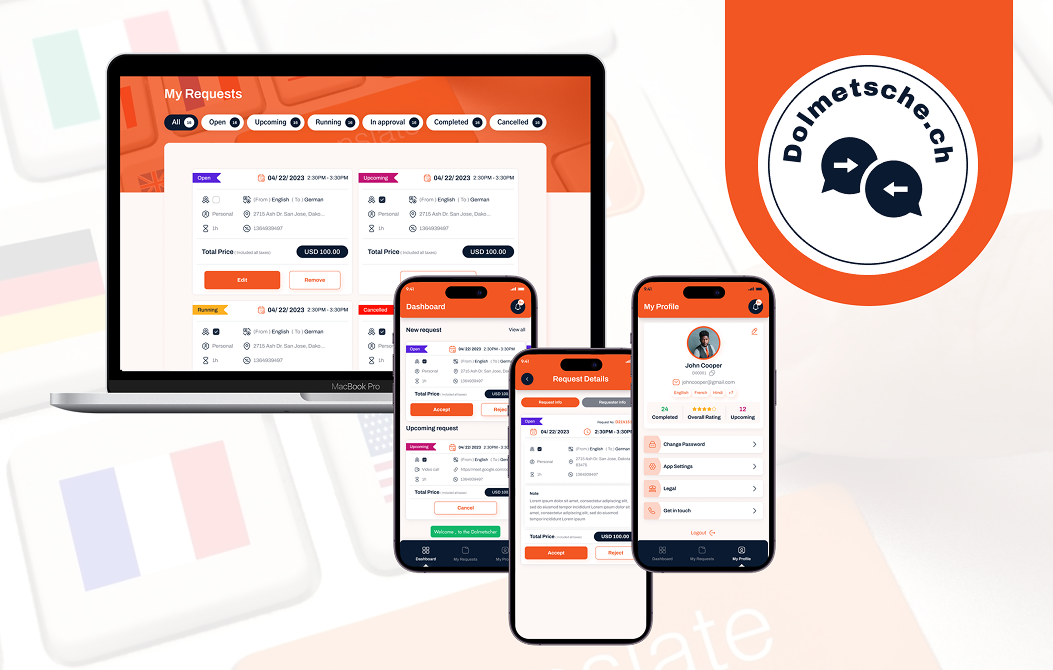
A Full-Stack Translation Service IT Solution
 Strategy
 UI/UX
Website
UI/UX
Website
 Mobile App
 Back-End
 Admin
Admin
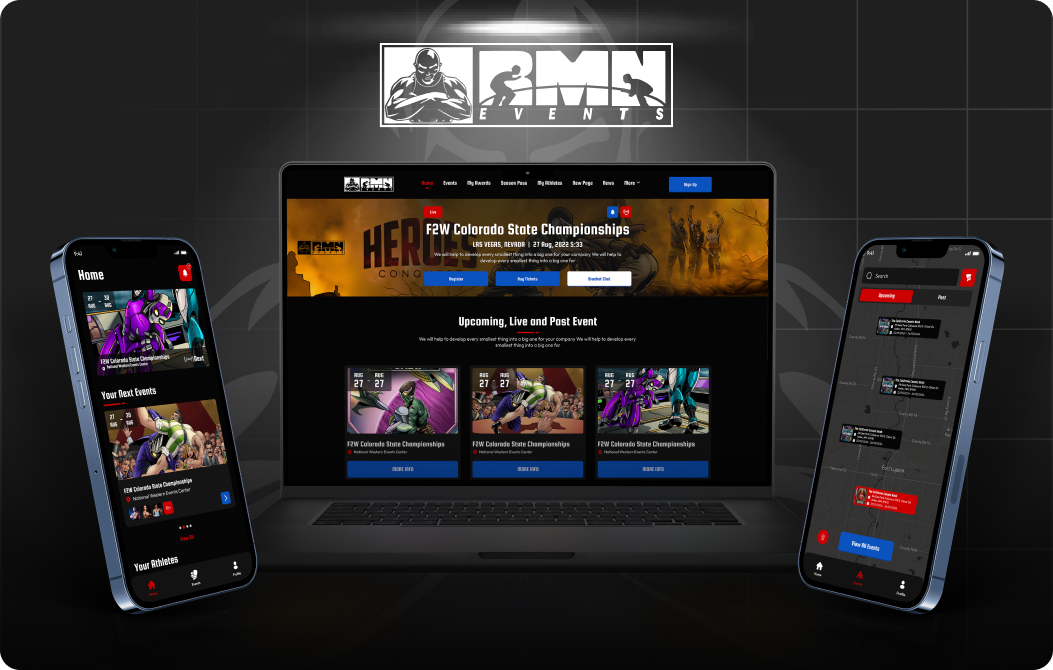
Digitizing the USA’s #1 Kids Wrestling League
Strategy
UI/UX
Website
Mobile App
Back-End
Admin
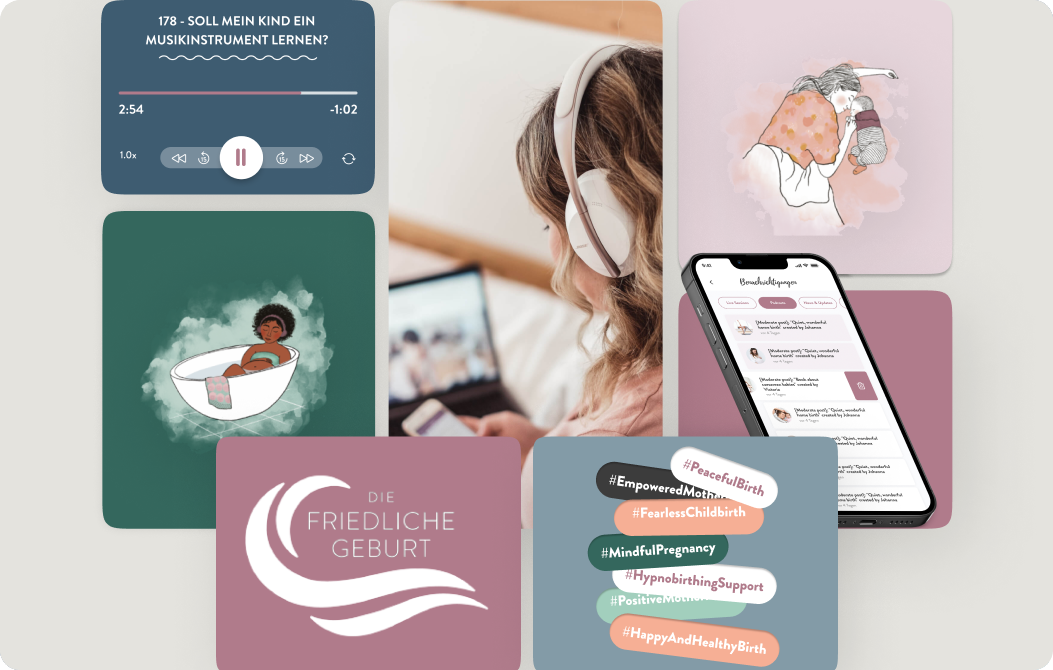
Germany's #1 Birth Preparation
Strategy
UI/UX
Mobile App
Back-End