

Step 1
Product Design
Our services deliver measurable results
We use AI across planning, design, and development to reduce waste, speed up delivery, and improve quality, without increasing budgets.

We joined at the very beginning, when OfficeActor existed only as an idea and a set of requirements. We took full ownership of product design, frontend, backend, and admin panel from day one through launch.
Brands and companies that want to find, vet, and book influencers without manual back-and-forth. And for influencers who want a professional platform to manage inquiries, contracts, and payments in one place.
 Product Design
 Website & Back-End
 202
Views
202
Views

Marlon B.
Founder & CEO
Marlon B. saw a clear gap in the market: companies wanting to collaborate with influencers had no structured way to find, evaluate, and book them. Everything happened through DMs, spreadsheets, and informal agreements. At the same time, influencers had no professional tool to manage incoming requests, track contracts, or get paid reliably. The idea was to build a two-sided platform that gives both parties a clean, structured workflow - from discovery to signed contract to payment.
We designed and built OfficeActor as a full-stack web platform with separate experiences for companies and influencers, a shared booking and contract engine, and a central admin layer. Companies search and filter influencers by category, location, and rating. They book directly, select packages and add-ons, and pay via Stripe. Influencers receive professional requests, manage their availability, and get paid reliably on completion. The platform eliminates DMs, spreadsheets, and informal agreements entirely.
Step 1
Product Design
Step 2
Implementation
Step 3
Quality Assurance
Step 4
Deployment & Operation
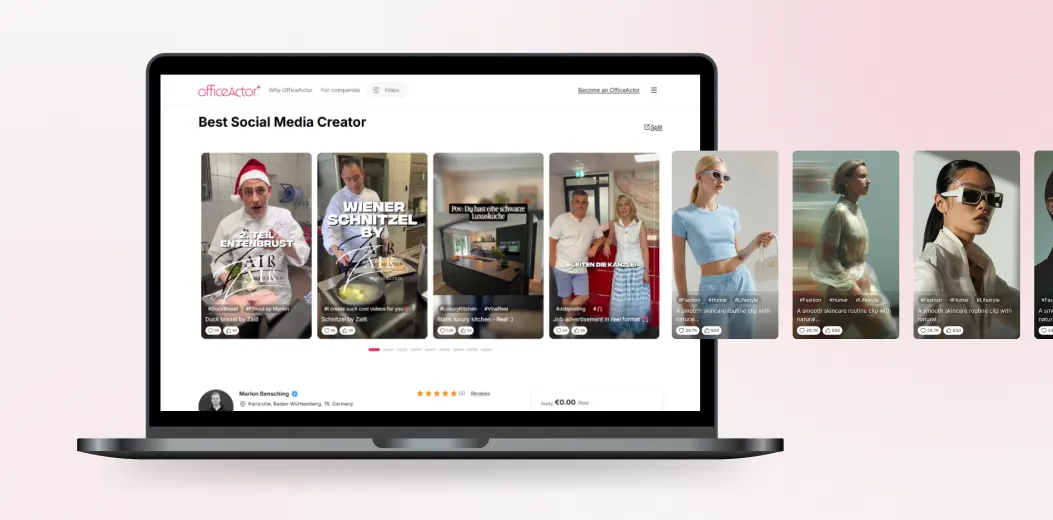
Companies browse a searchable, filterable marketplace of verified influencers. Filters cover category, location, rating, and availability. Location search is powered by Google Maps with radius-based discovery. Each influencer has a detailed profile page showing services, packages, pricing, references, and reviews. This removes the main friction of influencer marketing - finding the right match quickly and with full transparency.
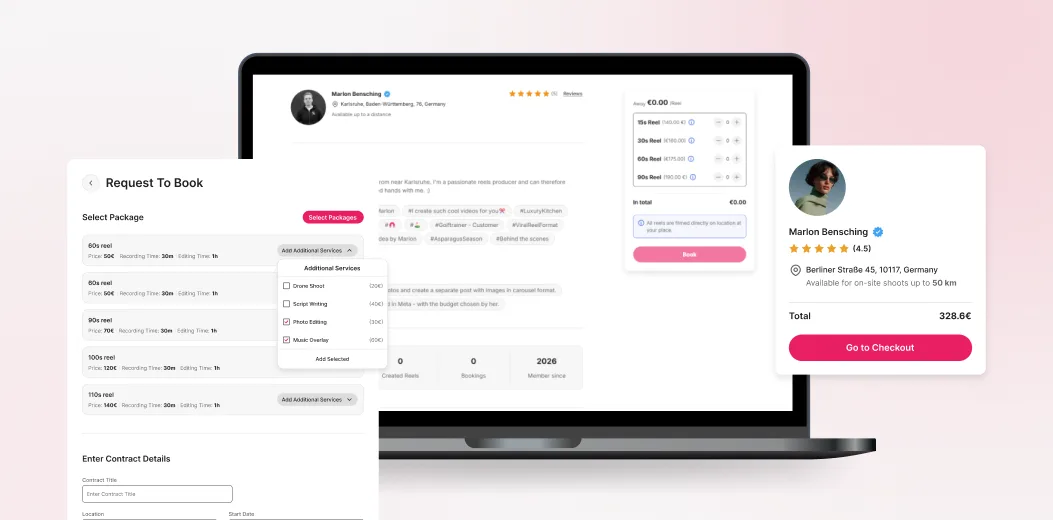
Companies book influencers directly from their profile without any off-platform contact. The flow guides the company through package selection, additional services, contract details, and Stripe checkout. Influencers receive the request and can accept or reject before payment is triggered. This end-to-end flow eliminates email negotiations and manual agreements entirely.
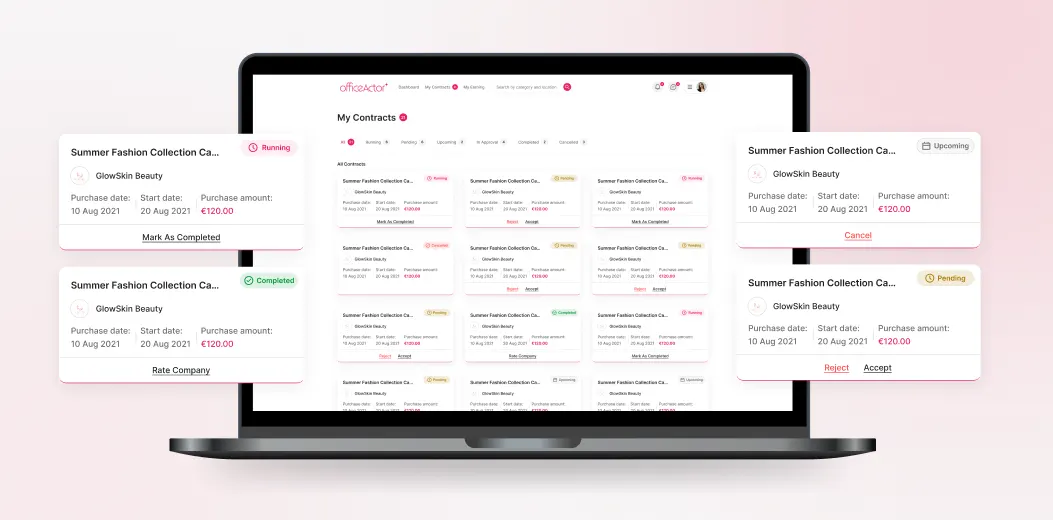
Every booking generates a live contract with a 10-stage automated status engine. Statuses move from pending through accepted, payment pending, running, completed, and reviewed - each with defined CTAs for both parties. Company and influencer see the same state in real time. This gives both sides legal clarity and removes ambiguity from the collaboration lifecycle.
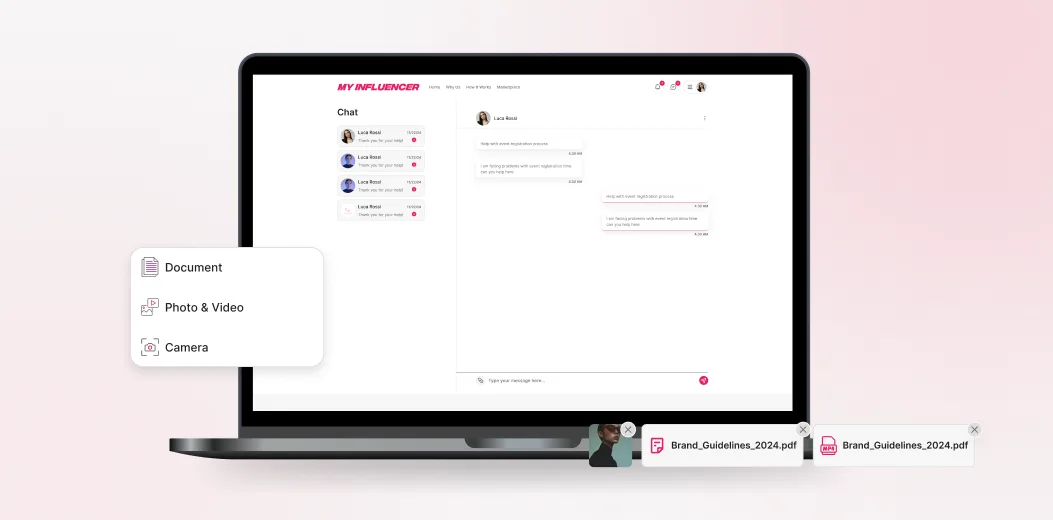
Every booking has a dedicated chat thread between company and influencer. Chat is contract-specific by default, keeping communication organized per project. Influencers can propose additional services directly in chat, which the company can accept and pay without leaving the platform. This keeps the full collaboration history in one place and eliminates scattered external communication.
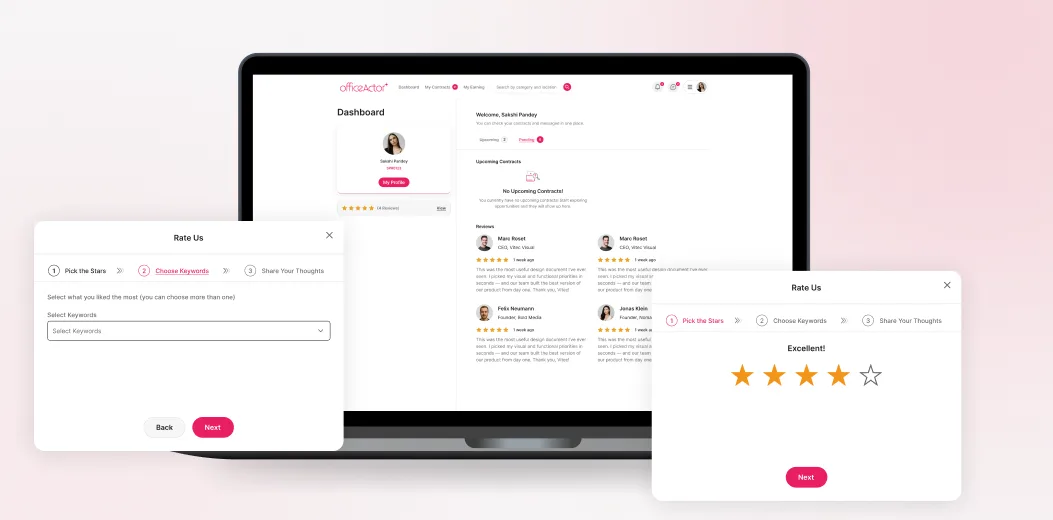
After every completed booking, both parties rate each other. Companies rate influencers on delivery and professionalism. Influencers rate companies on communication and reliability. Ratings build public reputation profiles that drive future booking decisions. This creates a self-regulating quality layer on both sides of the marketplace.
A full Angular-based admin panel gives the OfficeActor team complete platform control. Admins can manage influencer profiles, bookings, contracts, complaints, cancellation requests, reports, and the help center - all from one central interface. This makes day-to-day operations manageable without any engineering involvement.
The biggest challenge was designing and implementing the contract state machine correctly. With 10 distinct status stages and different CTAs for each party at each stage, the logic had to be airtight. A mistake in status transitions - for example, allowing payment before the influencer accepted - would break trust on both sides immediately.
Two-sided platforms live or die by the integrity of their transaction logic. The UX on top can be polished and simple - but the state machine underneath must be exhaustive and tested against every edge case before launch. No amount of good UX compensates for a broken contract flow.
Any marketplace or platform that manages a transaction between two parties faces this same challenge. Whether it is booking, hiring, renting, or contracting - the status model must be designed before any UI is built.
Design your transaction state machine before you design a single screen. On two-sided platforms, the contract logic is the product - get it right first and everything else follows.
The most special part of building OfficeActor was implementing the full contract state machine - ten statuses, two parties, zero ambiguity. On the surface it looks like a simple status badge on a booking. Underneath it is the entire logic that makes trust possible between a company and an influencer who have never worked together before. Every status transition required us to ask: what can the company do here? What can the influencer do? What happens if one side cancels mid-flow? What if payment fails after acceptance? We documented and mapped every single path before writing a line of backend code. When we finally saw the full flow run end-to-end in testing - from a company's first click to both parties leaving reviews - it was one of those moments where a complex system just works exactly as it should. That is the kind of engineering that does not get noticed by users. It only gets noticed when it breaks. We made sure it never does.
 Marlon B.
Founder & CEO
5.0
Marlon B.
Founder & CEO
5.0
We brought a complex product vision to Vitec and they structured it from the first design screen to the last API endpoint. The team built everything in one coherent flow - design, frontend, backend, and admin. We launched with full functionality and a clear path to scale.
Every successful project leaves behind measurable results and a clear path forward.
The references below show how we work, what we deliver, and the outcomes our partners achieve with us.
 STRATEGY
 UI/UX
UI/UX
 SAAS
SAAS
 WEB DEVELOPMENT
PCapital - How a Cybersecurity Expert Became a Software Company
WEB DEVELOPMENT
PCapital - How a Cybersecurity Expert Became a Software Company
 Karoly Aczel
Founder & CEO, Perpetuum Capital Ltd.
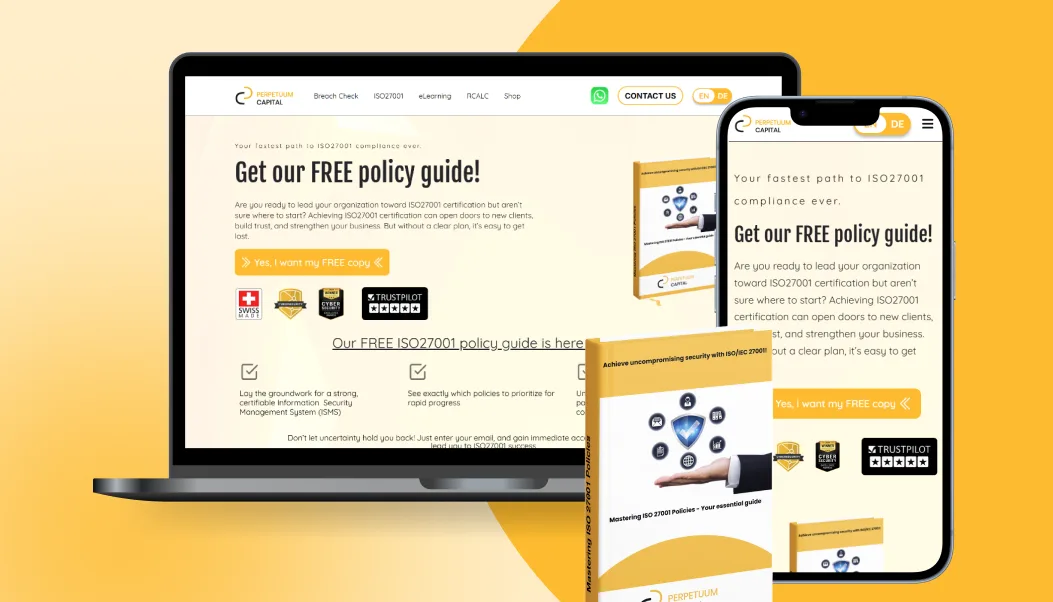
The founding team had years of hands-on ISO 27001 consulting experience and knew exactly what companies needed to get certified - but everything was delivered manually, one client at a time. The gap was clear: companies wanting ISO 27001 certification were either paying expensive consultants for work that could be structured into a guided tool, or they were lost in documentation without any support. The idea was to build two things that work together: a professional website that builds trust and sells digital products, and a SaaS application called Sentinel that guides organizations through ISO 27001 certification and ongoing ISMS management without needing a consultant in the room.
One-person consultancy → platform business
Use case
Karoly Aczel
Founder & CEO, Perpetuum Capital Ltd.
The founding team had years of hands-on ISO 27001 consulting experience and knew exactly what companies needed to get certified - but everything was delivered manually, one client at a time. The gap was clear: companies wanting ISO 27001 certification were either paying expensive consultants for work that could be structured into a guided tool, or they were lost in documentation without any support. The idea was to build two things that work together: a professional website that builds trust and sells digital products, and a SaaS application called Sentinel that guides organizations through ISO 27001 certification and ongoing ISMS management without needing a consultant in the room.
One-person consultancy → platform business
Use case
 STRATEGY
UI/UX
STRATEGY
UI/UX
 MOBILE APP
 BACK-END
 ADMIN
fame-tec - Digitalizing Industrial Fluid Monitoring
Yunus-Emre Akarca
CEO, fame-tec GmbH
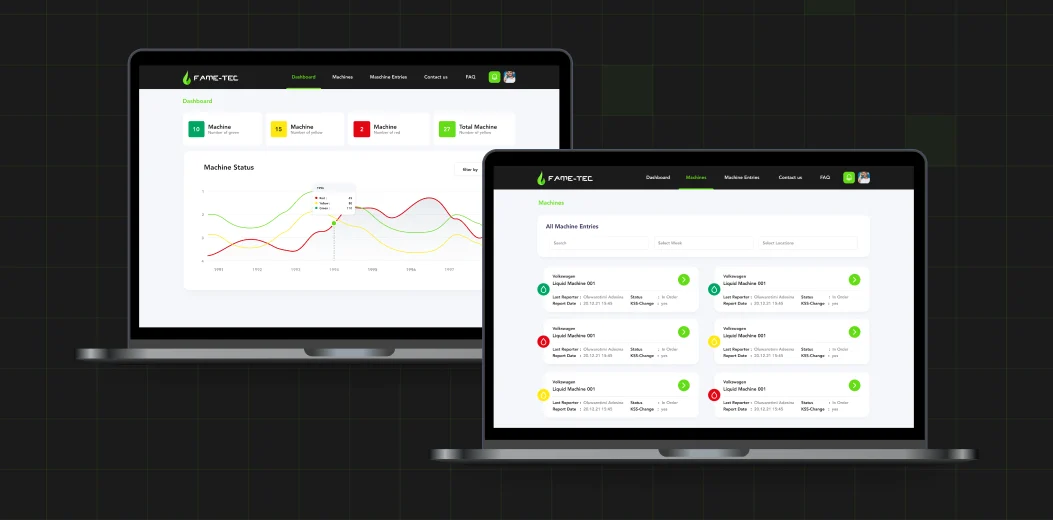
fame-tec is a fluid management company responsible for maintaining liquid conditions in on site industrial machines.Manual processes made it difficult to track machine status, detect issues early, and document maintenance reliably.The idea was to replace paper based workflows with an automated digital solution that allows employees to access machine data instantly, update fluid values on site, and give customers transparency into the condition of their machines.Reducing manual effort, preventing errors, and improving operational control were the core motivations behind the project.
35%
fewer support requests
Use case
ADMIN
fame-tec - Digitalizing Industrial Fluid Monitoring
Yunus-Emre Akarca
CEO, fame-tec GmbH
fame-tec is a fluid management company responsible for maintaining liquid conditions in on site industrial machines.Manual processes made it difficult to track machine status, detect issues early, and document maintenance reliably.The idea was to replace paper based workflows with an automated digital solution that allows employees to access machine data instantly, update fluid values on site, and give customers transparency into the condition of their machines.Reducing manual effort, preventing errors, and improving operational control were the core motivations behind the project.
35%
fewer support requests
Use case





 Behance


