


The EU AI Act has applied in large parts since 2 August 2026, and if you build, buy or embed AI software, you now need to know which duties actually affect you. At the same time, a late amendment moved the deadlines for high-risk systems. This article sorts out what applies today, what comes next and what you should check in your own products, with links to the official sources.
- Since 2 August 2026 most of the EU AI Act applies, including the transparency duties for chatbots and AI content.
- The Digital Omnibus moved the high-risk deadlines to 2 December 2027 (Annex III) and 2 August 2028 (Annex I).
- Chatbots must disclose at the first interaction that the user is talking to an AI.
- AI literacy has been mandatory since February 2025, even for internal tools.
- Fines reach up to EUR 35 million or 7 % of turnover; for SMEs the lower amount applies.
Want to learn more?
In a free strategy call we answer your questions about cost, technology and process.
Book a callWhat is the EU AI Act?
The AI Act is Regulation (EU) 2024/1689. It entered into force on 1 August 2024 and applies directly in every EU member state, without a national transposition law. Its logic is risk-based: the more an AI system can harm health, safety or fundamental rights, the stricter the rules.
Two roles matter for most companies. A provider develops an AI system, or has one developed, and places it on the market or puts it into service under its own name. A deployer uses an AI system under its own authority in a professional context. If you have a chatbot built for your website and run it under your brand, you are usually the provider of that system, even if the language model behind it comes from someone else. Providers and deployers outside the EU are covered as soon as their system or its output is used in the EU.
Timeline: what applies since when (as of November 2026)
The obligations come in stages. The EU Commission's official implementation timeline already includes the changes from the Digital Omnibus on AI:
| Date | What applies |
|---|---|
| 2 February 2025 | Prohibited AI practices are banned, and the duty to build AI literacy applies. |
| 2 August 2025 | Obligations for providers of general-purpose AI models (the large language models), plus governance and penalty rules. |
| 2 August 2026 | Most of the regulation applies, including the transparency duties of Article 50. Enforcement starts. |
| 2 December 2026 | Two new prohibitions (non-consensual sexual deepfakes and child sexual abuse material) and the end of a grace period for machine-readable marking of AI content in systems that were already on the market before 2 August 2026. |
| 2 December 2027 | Rules for high-risk systems in the areas listed in Annex III (for example HR, credit, education). |
| 2 August 2028 | Rules for high-risk AI embedded in regulated products such as machinery or medical devices (Annex I). |
The last two dates are new. Originally they were 2 August 2026 and 2 August 2027. The Digital Omnibus on AI, Regulation (EU) 2026/1744, entered into force on 27 July 2026 and moved them back. The transparency duties for chatbots and AI-generated content were not postponed.
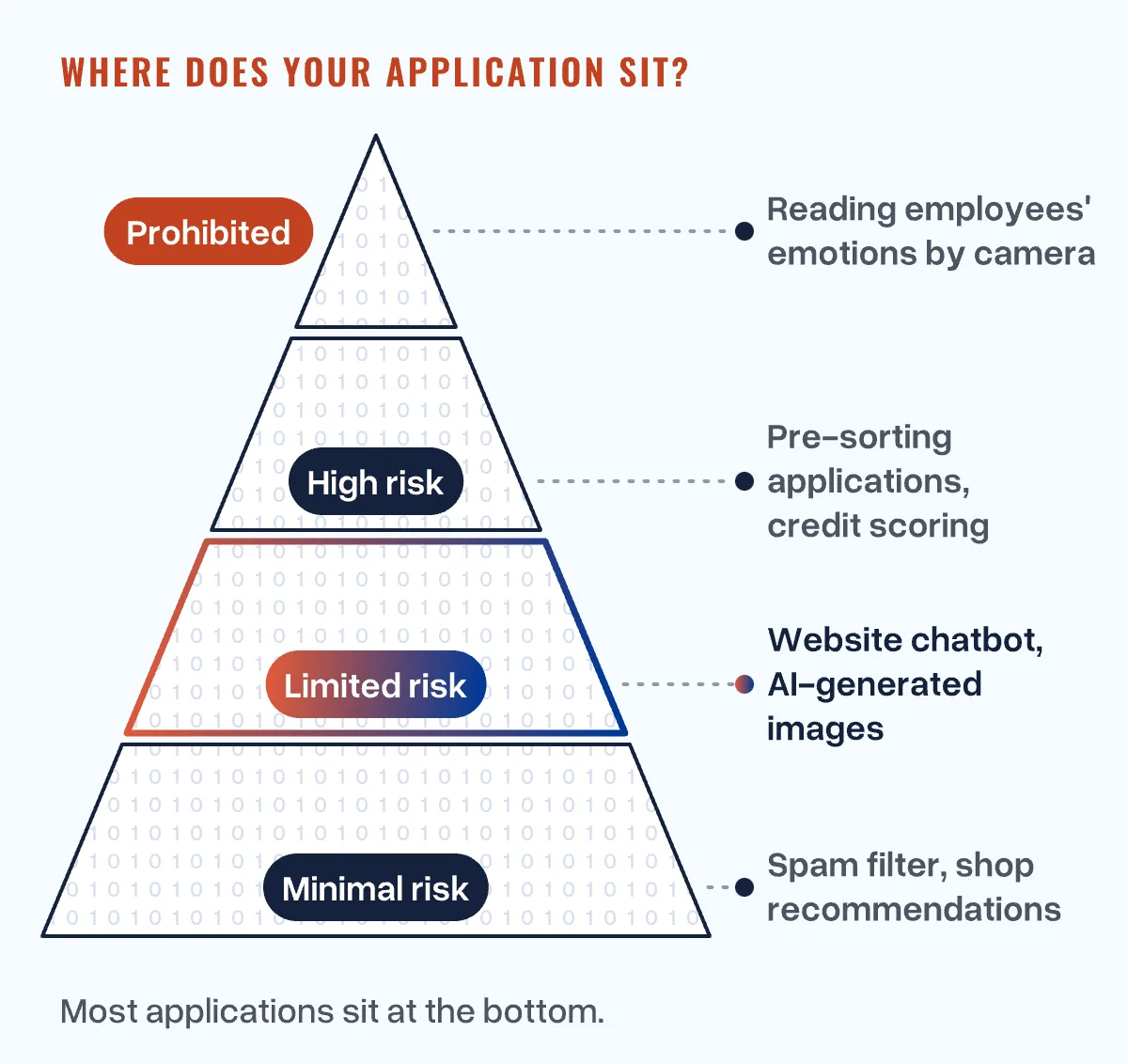
The four risk levels
-
Prohibited
- Examples
- Social scoring, manipulative techniques that cause significant harm, emotion recognition in the workplace and in education, and untargeted scraping of facial images (Article 5)
- What applies
- Banned since 2 February 2025; two more prohibitions from 2 December 2026
-
High risk
- Examples
- AI in product safety (Annex I) and in sensitive areas (Annex III), such as recruitment and staff decisions, credit scoring, life and health insurance pricing, access to education, critical infrastructure
- What applies
- High-risk duties such as risk management, data quality, technical documentation, logging and human oversight: from 2 December 2027 (Annex III) and 2 August 2028 (Annex I)
-
Limited risk
- Examples
- Systems that interact with people or generate content
- What applies
- Transparency duties (Article 50), since 2 August 2026
-
Minimal risk
- Examples
- Everything else, such as spam filters, internal summaries or AI in a recommendation feature
- What applies
- No specific duties beyond AI literacy
Being in an Annex III area does not automatically make a system high risk. Article 6(3) exempts systems that only perform a narrow procedural task, improve the result of a completed human activity, detect decision patterns or deviations from them without replacing the human assessment, or do preparatory work, as long as they do not materially influence the decision. One exception always stays high risk: profiling of natural persons. You have to document the assessment before launch and still register the system in the EU database.
Disclosure duties: what applies to AI chatbots and AI content
For most companies, Article 50 is the part that matters now. It has applied since 2 August 2026 and covers four cases:
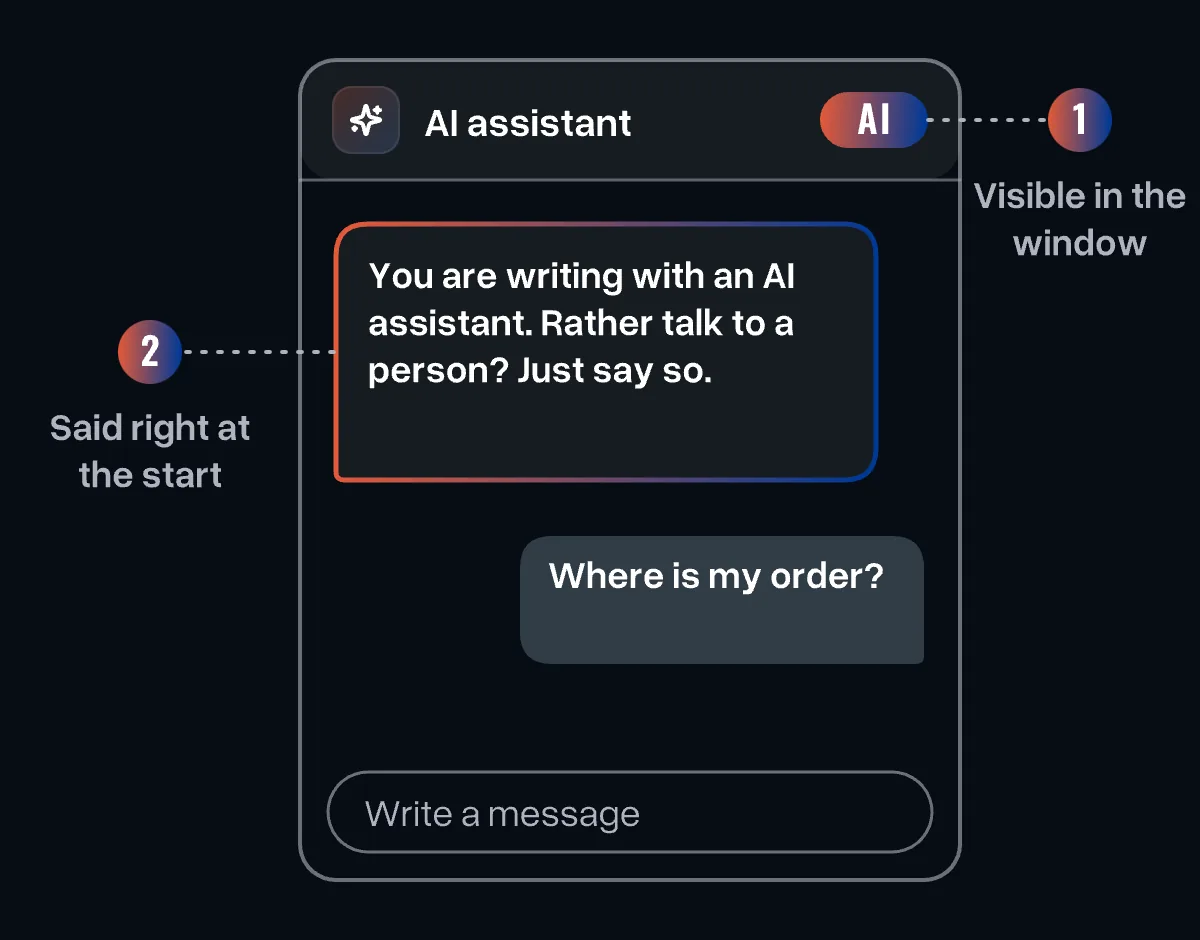
- Chatbots and assistants: people must be told they are interacting with an AI, at the latest at the first interaction, clearly and accessibly. The only exception is when this is obvious from the context, and the Commission reads that exception narrowly.
- Generated text, images, audio and video: providers of generative systems must mark the output in a machine-readable way so it can be detected as AI-generated.
- Deepfakes: whoever publishes realistic generated or manipulated images, audio or video must disclose it. For obviously artistic or satirical works a light notice is enough.
- AI-written texts on matters of public interest: must be disclosed, unless a person has reviewed them and holds editorial responsibility.
The Commission has published a code of practice on marking and labelling AI-generated content and an FAQ on Article 50. The code is voluntary, but it shows how authorities expect the duties to be met. How to set up a chatbot that meets these rules and data protection from the start is covered in our article AI chatbot for business.
AI literacy: the duty many companies overlook
The AI literacy duty has applied since 2 February 2025 (Article 4). Since the Digital Omnibus (27 July 2026) it reads: providers and deployers must take measures to support the AI literacy of their staff and of others who operate or use AI systems on their behalf; they do not have to guarantee a specific level. That applies even to an internal chatbot. No certificate is required, but you should be able to show what you did: short training on how the tool works, its limits and how to handle data, adapted to each role.
What happens if you break the rules
The fines in Article 99 have three tiers:
| Violation | Fine up to |
|---|---|
| Prohibited practices | EUR 35 million or 7 % of worldwide annual turnover |
| Most other duties, including the transparency rules | EUR 15 million or 3 % |
| Incorrect information given to authorities | EUR 7.5 million or 1 % |
Large companies pay whichever is higher. For SMEs and start-ups the lower of the two amounts applies.
In Germany, the national implementing law has been in force since 29 July 2026: the KI-Marktüberwachungs- und Innovationsförderungsgesetz (KI-MIG). It gives the Bundesnetzagentur the central role in supervision.
Three typical cases
A chatbot in customer service
A chatbot that answers questions from your documents is limited risk. You need the AI disclosure at the start of the chat, a route to a human, and the usual GDPR basics: what data the chat stores, where the model runs and a data processing agreement with the provider. More on this in integrating AI into existing software.
AI that pre-sorts job applications
Filtering or ranking applicants is listed in Annex III and is high risk. The full duties apply from 2 December 2027: risk management, data quality, technical documentation, logging, human oversight, accuracy and registration. Building such a system today means designing for these requirements from the start, because adding them later is expensive.
AI that summarises internal documents
Summaries of meeting notes or contracts for internal use are usually minimal risk. AI literacy applies, and of course data protection. If summaries are published as information on matters of public interest, the disclosure duty for texts can apply, unless a person reviews and signs off.
Checklist: how to proceed now
- List every AI system you build, buy or use, including AI features inside existing tools.
- Clarify your role for each one: provider, deployer or both.
- Assign each system a risk level and document why, especially if you rely on the Article 6(3) exemption.
- Check every chatbot and assistant: is the AI disclosure shown at the first interaction?
- Check generated content: do your tools mark it, and do you label deepfakes and published AI texts?
- Document your AI literacy measures per role.
- For anything in an Annex III area, plan the high-risk requirements now, with the deadline of 2 December 2027.
How Vitec helps with AI software under the AI Act
We are a software development partner from Stuttgart and build AI solutions for companies: chatbots, AI agents and AI features in existing software. Which AI Act duties apply to your project is something we clarify before the start, together with you, and we build the technical side in from day one: the AI disclosure in the chat, a handover to a person, logging, and a human who approves wherever it matters.
We choose the model, hosting and data flow to match your data protection requirements, including open-source models hosted in the EU. We start with a prototype on your real data, then build it out for production with fixed test cases that run before every release. And we tell you honestly when classic software without AI is the better fit. Learn more on our AI development page or book a free strategy call.
Conclusion
For most companies, the AI Act in 2026 is less dramatic than its reputation: transparency, AI literacy and a clear overview of your own systems cover the bulk of it. It gets demanding in the high-risk areas, and the extra time until December 2027 is best used for planning, not for waiting.