

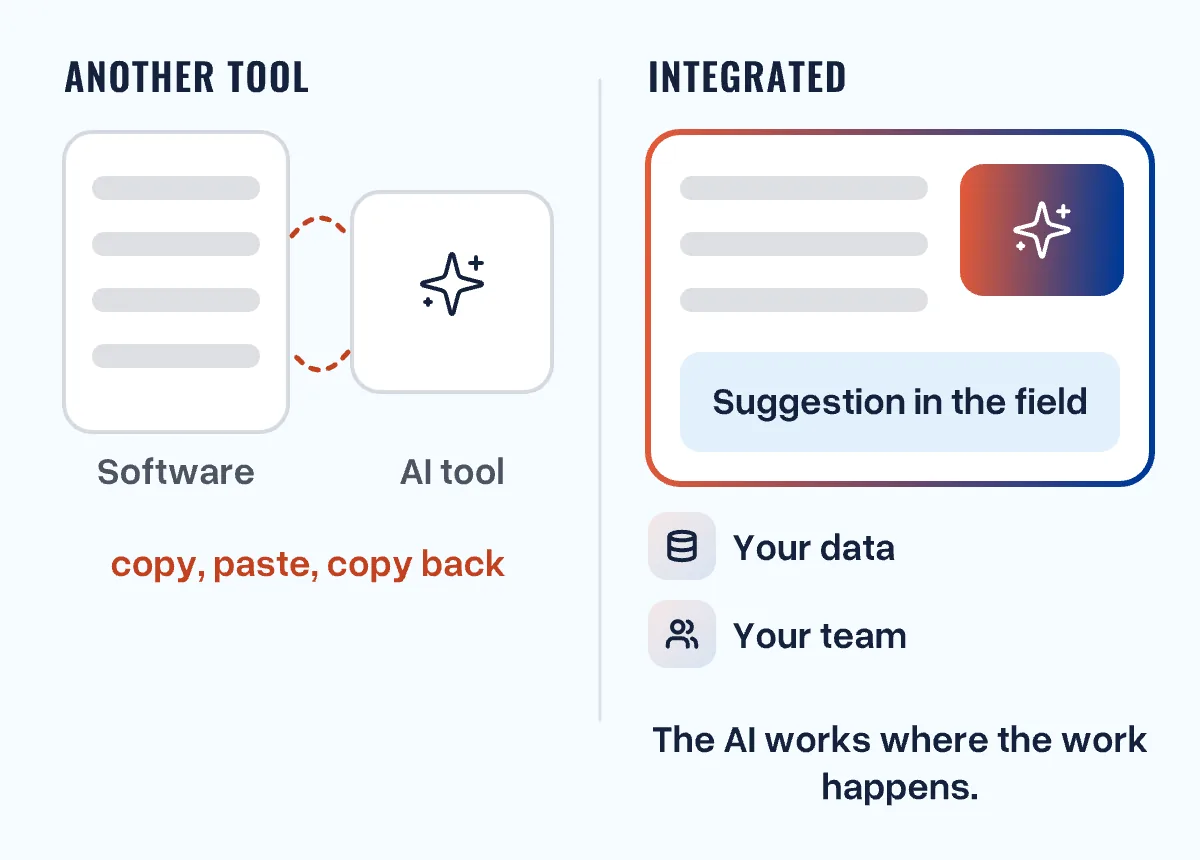
AI integration into your existing software is often the fastest route to measurable benefit, because the data, the users and the workflows are already there. Instead of introducing yet another tool, the AI works where your team already works: in the CRM, the customer portal, the ERP or your own app. This article shows the four common approaches, what drives the effort, which risks you need to manage and how to proceed step by step.
- Integrating AI into existing software brings it to where data, users and workflows already are.
- Four approaches: an API function, answers from your own data (RAG), agents that act, and self-hosted models.
- The model is rarely the cost driver: infrastructure, data preparation and integration are named far more often as large cost items.
- Key risks are wrong answers, data protection, prompt injection, runaway costs and vendor dependency, and each has a technical answer.
- Start with one step, a measurable goal and a prototype on real data.
Want to learn more?
In a free strategy call we answer your questions about cost, technology and process.
Book a callWhy integrate AI instead of buying another tool?
AI has arrived in German companies: according to Bitkom's September 2026 survey, 57 % of companies with 20 or more employees now use AI, up from 36 % a year earlier. Much of that is general chat tools. They help individuals, but they do not change a process: the data stays in the core system, and someone copies it back and forth.
Whoever only buys a licence has bought AI, but has not changed anything yet.
Ralf Wintergerst, Bitkom president, press release of 14 September 2026 (translated)
Integration solves exactly this. The AI sees the data it needs at the point where the work happens, and its result lands directly where it is used: as a field, a draft, a suggestion or a flag in the software your team already knows.
Four ways to integrate AI into existing software
-
1. An AI function via API (LLM integration)
- How it works
- The simplest way: your software sends a request to a language model and uses the response. Technically this is a well-defined interface.
- Typical use
- Summarising long texts, classifying incoming requests, extracting fields from documents or drafting replies
- Effort and what to watch
- The smallest step. The work lies in good instructions, clean input data and tests.
-
2. Answers from your own data (RAG)
- How it works
- With retrieval-augmented generation (RAG), the system first searches your documents, manuals or tickets for the relevant passages and gives only those to the model. The answer is then based on your knowledge and can cite the source.
- Typical use
- The standard approach for internal knowledge assistants and support chatbots
- Effort and what to watch
- Medium effort, between a single function and an agent.
-
3. An AI agent that takes actions
- How it works
- It not only answers, it acts in your systems.
- Typical use
- Sorting a request, creating a ticket or preparing a booking
- Effort and what to watch
- The most effort. Brings the most benefit and needs the most care with rights and approvals. We explain how this works in AI agents for business.
-
4. A self-hosted or EU-hosted model
- How it works
- Open-source models run on your own servers or with an EU hosting provider. You gain control over data and costs.
- Typical use
- Data that must not leave your environment
- Effort and what to watch
- The most effort: you take on operation, updates and quality assurance yourself. Often a mix makes sense: sensitive parts such as the document search run locally, the rest via an API.
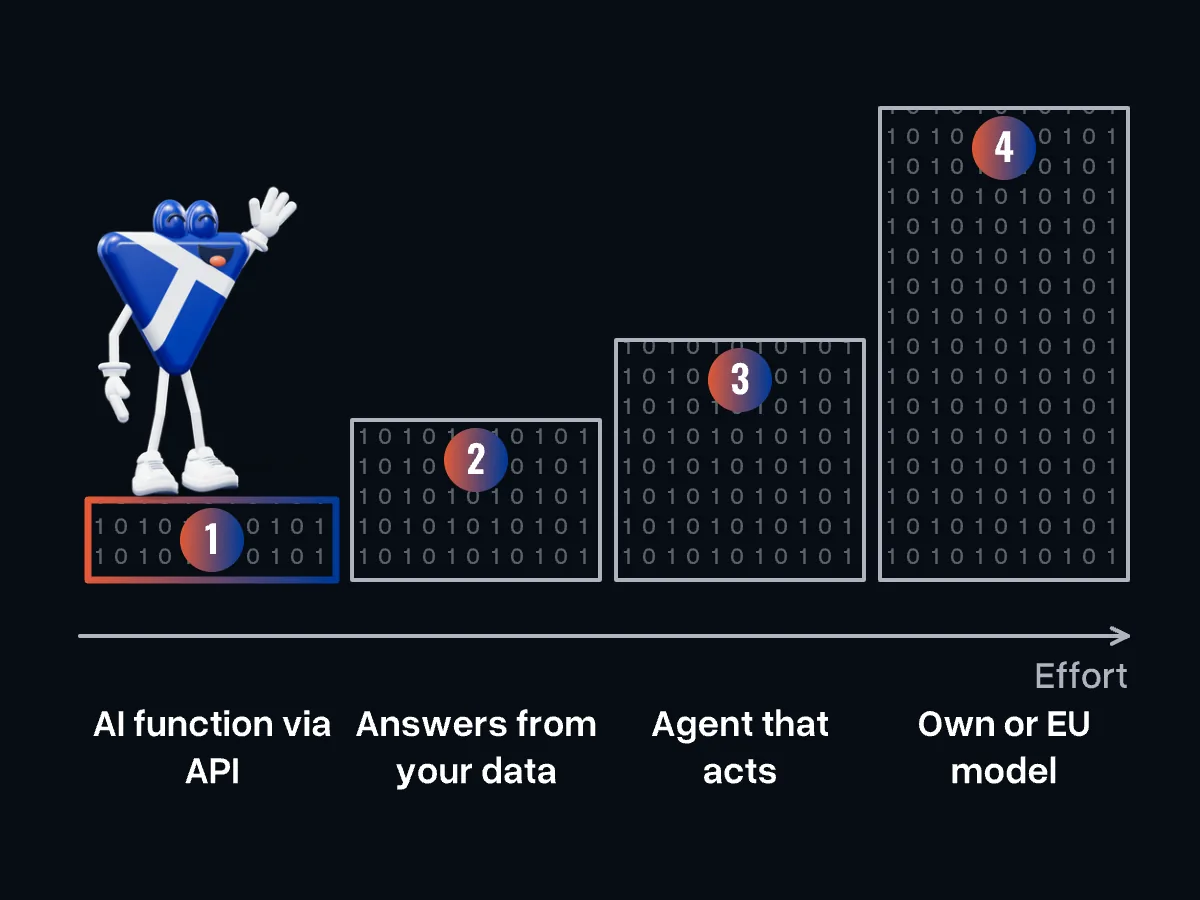
Each step delivers value on its own, and each one teaches you something about your data before you invest in the next.
What drives the effort of an AI integration
The same Bitkom survey shows where the money really goes. Among companies that already use AI, these items are named as a large cost item:
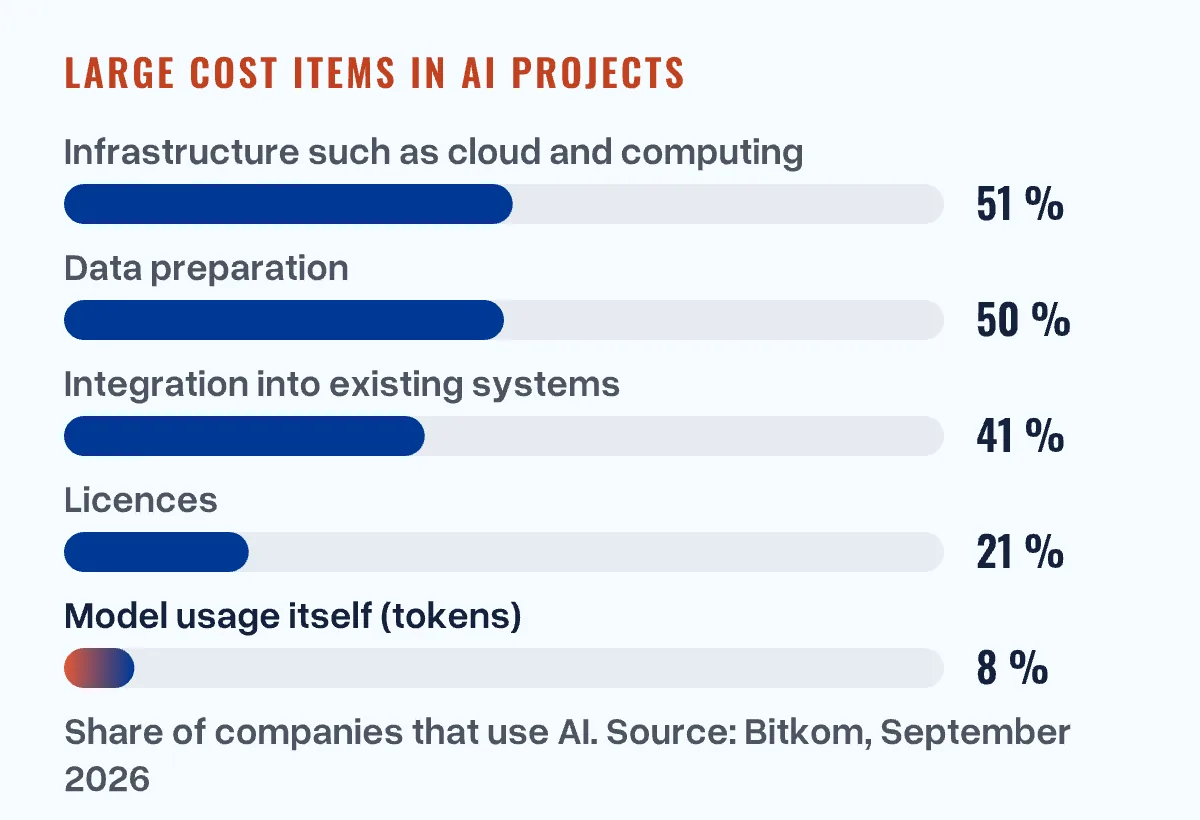
In other words: the model is rarely the expensive part, the work around it is. That is also what we see in our projects: most of the effort goes into data and integration.
- State of your software: a documented API makes integration easy; old systems without interfaces need an adapter first.
- Data quality: scattered, outdated or contradictory documents produce poor answers. Preparing them is often the biggest single item.
- Approach: a single API function is the smallest step, RAG is in the middle, agents with actions and self-hosted models take the most effort.
- Quality assurance: test cases with known correct results, run before every change.
- Data protection and compliance: data flows, hosting location, contracts and the duties from the AI Act.
As rough orientation: a single AI function in an application with a good API is often a matter of a few days to a few weeks. Answers from your own data with RAG usually take a few weeks. An agent with actions or a self-hosted model tends to need several weeks to a few months. Running costs depend on the model and the volume of requests, and the price difference between models is large.
Risks and how to manage them
- Wrong answers: language models can sound convincing and still be wrong. Answers with sources, fixed test cases and a person who takes over when the AI is unsure reduce this risk.
- Data protection: 66 % of companies using AI name data protection requirements as an obstacle (Bitkom). Clarify which data the model may see, where it is processed, and conclude a data processing agreement under the GDPR.
- Manipulated inputs: instructions hidden in emails or documents can mislead the model. OWASP lists this prompt injection as the number one risk for LLM applications. Minimal rights and approvals for important actions are the answer.
- Costs that run away: without limits, a loop or a flood of requests can become expensive. OWASP calls this unbounded consumption. Set limits and monitor cost per request.
- Vendor dependency: keep the model behind your own interface, so you can switch models without rebuilding the application.
- Regulation: chatbots must disclose that they are AI, and high-risk areas such as recruitment have stricter rules. Details in our article on the EU AI Act 2026.
- Acceptance in the team: 42 % of companies using AI report a lack of employee acceptance (Bitkom). Involve the people who will work with the function from the start.
Step by step: introducing AI in your company
- Find the right step: where does your team spend a lot of time reading, weighing up and passing on information? That is where AI helps. Where the rules are clear, classic automation is enough.
- Define success: processing time, error rate or the share of cases without correction. Without a measure, you cannot decide later whether it works.
- Check data and interfaces: which data does the function need, how good is it, and how does the AI get to it?
- Build a prototype on real data: small, quick and with test cases, so that you see results instead of slides.
- Integrate with safeguards: logging, limits, rights, a handover to a person and the AI Act disclosure where needed.
- Train the team: how the function works, where its limits are and when a person must check. This also supports the AI literacy the AI Act asks for.
- Measure and improve: track quality and cost per request in operation and extend step by step.
How Vitec integrates AI into existing software
We are a software development partner from Stuttgart and build new AI functions where your data and users already are: in your web application, your portal, your app or alongside your ERP. We start with the question of which step should become easier, build a prototype on your real data and only then integrate it for production, with tests before every release and a handover to your team whenever the AI is unsure.
We choose model, hosting and data flow to match your data protection requirements: Claude, GPT, Gemini or open-source models in the EU, and parts like the document search can run locally. We also develop with AI ourselves; at weguide this cut the time to market by 50 %. And if classic software is the better fit for your problem, we tell you before the project starts. More on our AI development page, or request a quote for your integration.
Conclusion
AI integration works best as a series of small, measurable steps in the software your team already uses. Start with one well-chosen step, invest in data and tests rather than in the biggest model, and keep a person in the loop where it matters. That is how AI changes a process instead of just adding another licence.