

Vibe coding means you describe in plain language what an application should do, and an AI writes the code. Within hours you have something that works, at least at first glance. The question many companies are asking in 2026: can you build software this way that customers and employees rely on? This article shows honestly what vibe coding is good for, where it ends, why development knowledge makes the difference and how professional teams use AI for programming.
- Vibe coding means generating software with AI without reading the code - coined by Andrej Karpathy in February 2025.
- It is strong for prototypes, internal tools without sensitive data, exploration and one-off scripts. A vibe-coded prototype is a good specification, but rarely a good foundation.
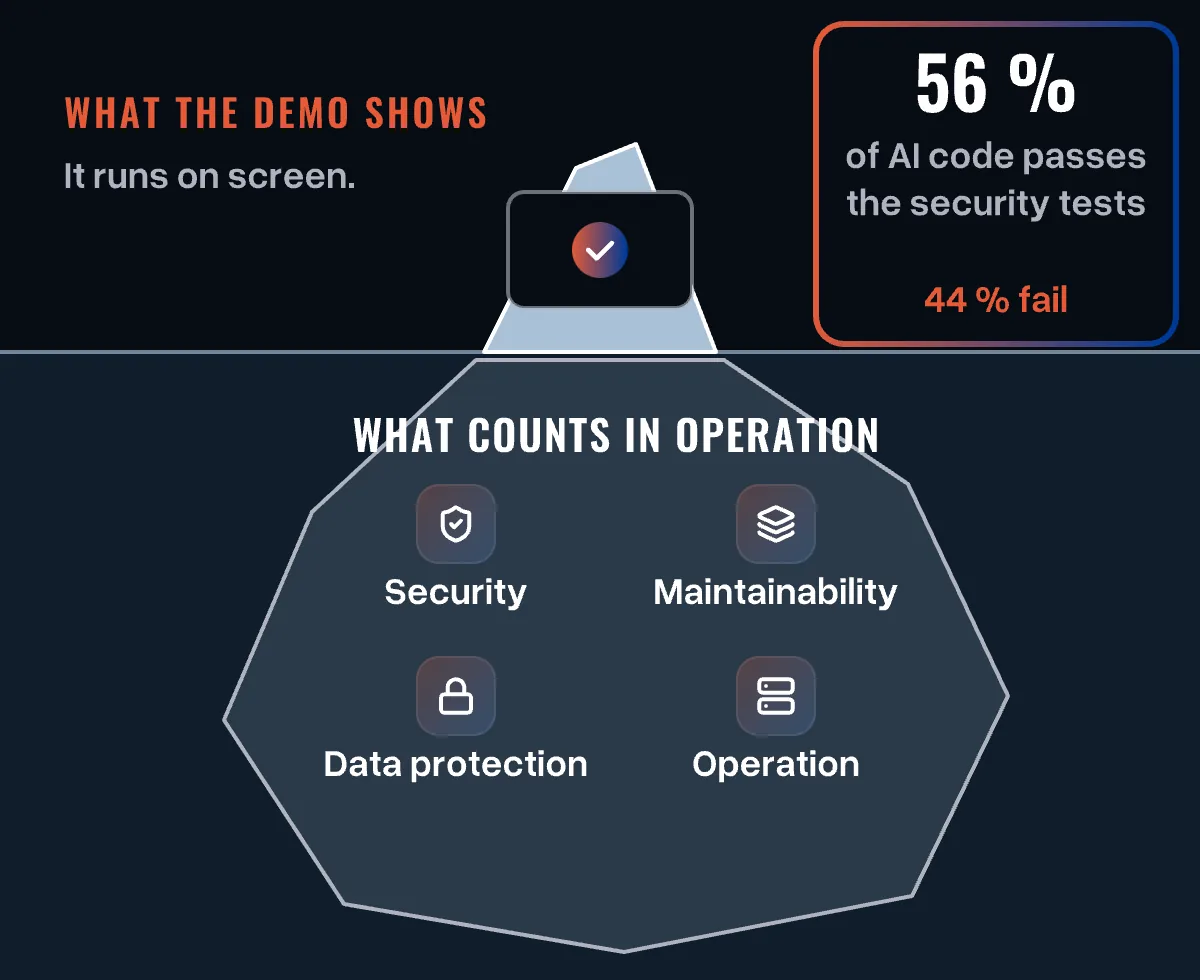
- It ends at security, maintainability, data protection and operation: in Veracode's 2026 report, AI code passed the security tests in only 56 % of cases.
- Someone with development knowledge prompts more precisely and can verify the result. Without that knowledge, the only test is whether it works on the screen, and flaws in access rules, data model or payment flow often surface months later.
- As soon as real users or data are involved, someone with development knowledge must define the task, review the result and own it.
Want to learn more?
In a free strategy call we answer your questions about cost, technology and process.
Book a callWhat is vibe coding?
The term comes from Andrej Karpathy, former AI lead at Tesla and a founding member of OpenAI. In a post on 2 February 2025 he described a way of working where you fully give in to the vibes and forget that the code even exists. He used it for throwaway weekend projects, by his own account. Less than a year later, Collins Dictionary named vibe coding its Word of the Year 2025.
The decisive point is not that an AI writes code. That happens in almost every development team today. The decisive point is that in vibe coding nobody reads the code. You judge the result only by whether the screen does what you wanted. If something breaks, you describe the error and let the AI try again.
Typical tools are app builders such as Lovable, Bolt or Replit, which generate a complete web app from a description, and AI editors such as Cursor, Claude Code or GitHub Copilot, which professionals also use, with a very different way of working.
What vibe coding is genuinely good for
Vibe coding is a real gain wherever speed matters more than durability. These are the strongest use cases:
- Clickable prototypes: you test an idea with real users before you invest in development. A prototype says more than twenty pages of specification.
- Internal tools for a small group: a small evaluation, a form, a dashboard for your own team, without sensitive data and without customers depending on it.
- Exploration: does this interface work as documented? Can the process be automated? Vibe coding answers that in hours instead of days.
- Shared understanding: business teams show what they mean instead of describing it.
- One-off scripts: converting a data export once, cleaning up a list, renaming files.
All of these cases have three things in common: a mistake causes little damage, the software has a short life, and no personal data is involved.
What the 2026 numbers say about AI in programming
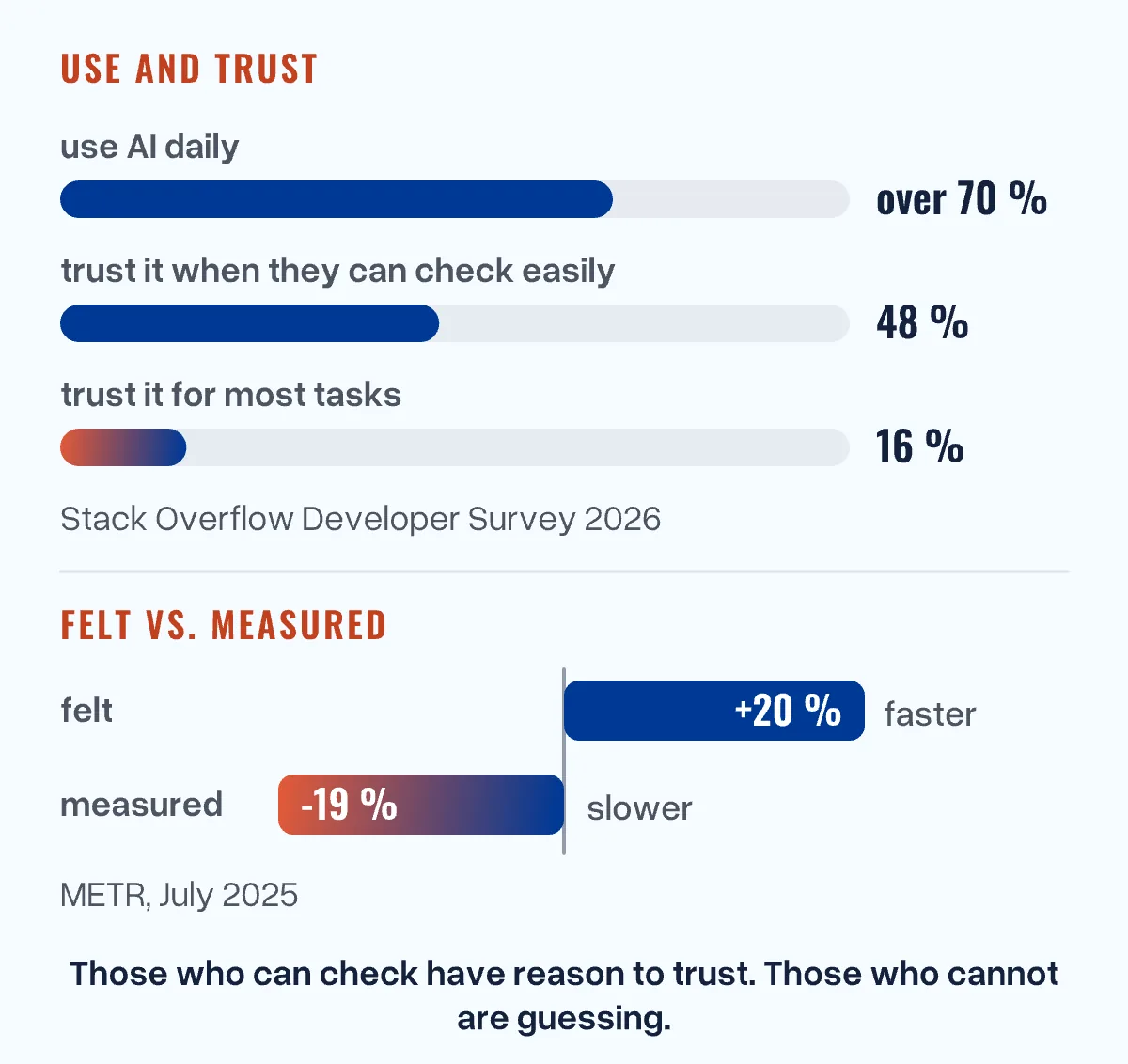
AI has long been part of everyday development. In the Stack Overflow Developer Survey 2026, over 70 % of respondents use AI daily. Trust has limits, though: 48 % trust AI when they can easily validate its answers, only 16 % extend that trust to most tasks that are not important work decisions. The 2026 survey has no question on vibe coding itself. In the 2025 survey, 72 % said vibe coding is not part of their professional work, and another 5 % said so emphatically.
On productivity, perception and measurement diverge: in a controlled study by METR (July 2025), experienced open-source developers took 19 % longer with AI and afterwards believed they had been 20 % faster. In its February 2026 update, METR considers a speed-up with newer tools likely, but calls its data on the size only very weak evidence.
Google's DORA Report 2025 (nearly 5,000 respondents, still the latest edition in November 2026) calls AI an amplifier: 90 % use it at work, higher delivery throughput goes along with lower delivery stability, and the weaknesses of teams grow just like their strengths.
Where vibe coding ends
The limits do not show up in the demo. They show up when real users, real data and the second year of operation arrive.
Security
Veracode regularly tests how secure the code of language models is. According to its GenAI Code Security Report 2026 (28 July 2026), the code of more than 100 models passed the security tests in only 56 % of cases on average, virtually unchanged since the previous year, although almost 100 % compiled without errors. The raw models were tested without human review - exactly what is missing in vibe coding. We see the same in our projects: whoever takes over AI code unreviewed almost always takes over gaps in access rights and input checks too.
What this looks like in practice was reported by The Register in February 2026: an app hosted on Lovable and showcased on the platform exposed 18,697 user records. One of 16 vulnerabilities: a check meant to protect admin functions blocked logged-in users and let users who were not logged in through. According to Lovable, part of the code was not generated by Lovable, and the findings of its built-in security scan had not been applied. What a secure app needs is covered in 9 security best practices.
Maintainability and architecture
Generated code works until the tenth change. Without tests, every new prompt can break something that worked yesterday. Architecture decisions such as how users, roles and data relate to each other are cheap at the start and expensive later. AI makes them silently if nobody makes them on purpose.
Data protection
As soon as personal data is involved, questions arise that a prompt does not answer: where is the data processed, who has access, how long are logs kept, is there a data processing agreement with every service involved?
Operation and scaling
Software in production needs backups, monitoring, updates and a plan for load peaks. AI agents with too many rights are a risk of their own, even for experienced teams: in April 2026, an AI agent in the Cursor editor deleted the production database of the software provider PocketOS, including its backups, in nine seconds, The Register reported. It was supposed to fix an access problem in the test environment and used an API key with full rights that it found in an unrelated file. The backups were stored in the same volume as the data; the data was restored with the help of the hosting provider.
Why development knowledge makes the difference in vibe coding
The same tool delivers very different results depending on who uses it. The difference is not clever prompting. It is knowing what an application has to do in operation, even when nobody said it out loud.
Those who know what has to be done prompt more precisely
A developer who has a booking feature generated thinks of the requirements that are in no description:
- Authentication and roles: who may see, change or delete what?
- Validation and error handling: what happens with empty, wrong or malicious input, and what happens when the payment service times out?
- Data model and migrations: how do customers, bookings and invoices relate, and how do you change the schema later without losing data?
- Operation: logging, backups, tests, performance with many simultaneous users.
- Data protection: which personal data is stored, for how long and where?
She writes these points into the prompt: data model, roles, security rules, edge cases. The AI has less to guess, and the first result is much more usable. Above all, she can then check it line by line: is it done the way it has to be done? Does the access rule really check who a record belongs to? This fits the Stack Overflow survey: 48 % trust AI when they can easily validate its answers.
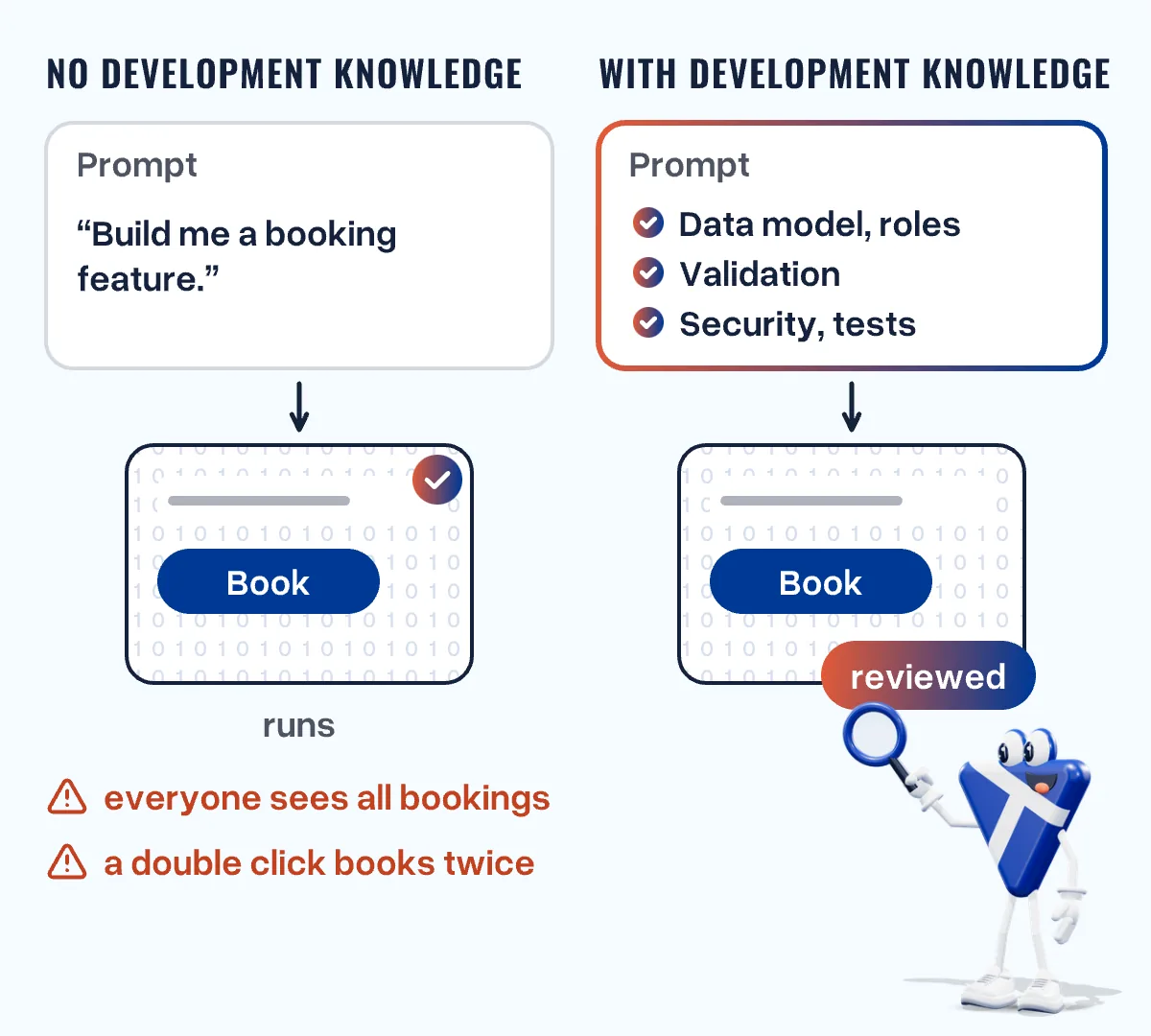
Without development knowledge, only one test is left: does it work on the screen?
Someone who cannot program cannot judge whether the task was solved correctly. The app looks finished, the click path works, the demo convinces. What happens behind it stays invisible.
The February 2026 case shows the pattern: the check was there, it just let the wrong people through. You do not see that by clicking, only by reading the code or with a targeted test. Asking the AI whether the code is secure does not replace that: if you cannot judge the answer, you have to believe it.
Why this is dangerous now, and even more so later
Now: security holes that expose customer data; data protection violations for which you as the operator are responsible, no matter who wrote the code; wrong business logic that produces wrong prices, double bookings or lost orders.
Later: nobody understands the code, not even the person who had it generated. Every change by prompt can break something elsewhere, and without tests nobody notices. The security debt grows with every feature until a customer, an auditor or an attacker finds the flaw, often months after launch. At some point rewriting is cheaper than repairing, except that by then real users and data depend on the old version.
How professional teams use AI coding differently
Professional teams also write a large share of their code with AI today. The difference lies in what happens around it:
-
Structure
- Vibe coding
- The AI makes architecture decisions silently if nobody makes them on purpose.
- Professional AI development
- People decide on the structure: data model, roles and security concept are set before the AI writes code.
-
Code
- Vibe coding
- Nobody reads the code. You judge the result only by whether the screen does what you wanted.
- Professional AI development
- Every line is reviewed: developers read and understand what the AI produces before it is merged.
-
Tests
- Vibe coding
- Without tests, every new prompt can break something that worked yesterday.
- Professional AI development
- Automated tests run with every change, so errors show up before users see them.
-
Security
- Vibe coding
- Nobody checks the generated code.
- Professional AI development
- Built-in security checks for dependencies, access rules and secrets.
-
AI agents
- Vibe coding
- AI agents with too many rights are a risk of their own.
- Professional AI development
- Clear limits for AI agents: no write access to production systems, backups kept separately, no real customer data in prompts without a legal basis.
-
Suited for
- Vibe coding
- Prototypes, internal tools without sensitive data, exploration and one-off scripts
- Professional AI development
- Software that customers and employees rely on
This way you get the speed of AI without giving up the reliability of engineering. What this means for budgets is explained in our article on software development cost in 2026.
Checklist: is vibe coding enough, or do you need professional development?
Answer these questions about your project. If you answer yes even once, plan professional development, even if you start with a vibe-coded prototype:
- Does the application process personal data or customer data?
- Will people outside your team use it, such as customers or partners?
- Does it need to run reliably for longer than a few weeks?
- Is it connected to other systems, such as ERP, CRM, payment or an existing database?
- Would an outage or an error cost money, customers or reputation?
- Does someone other than its creator need to maintain and extend it?
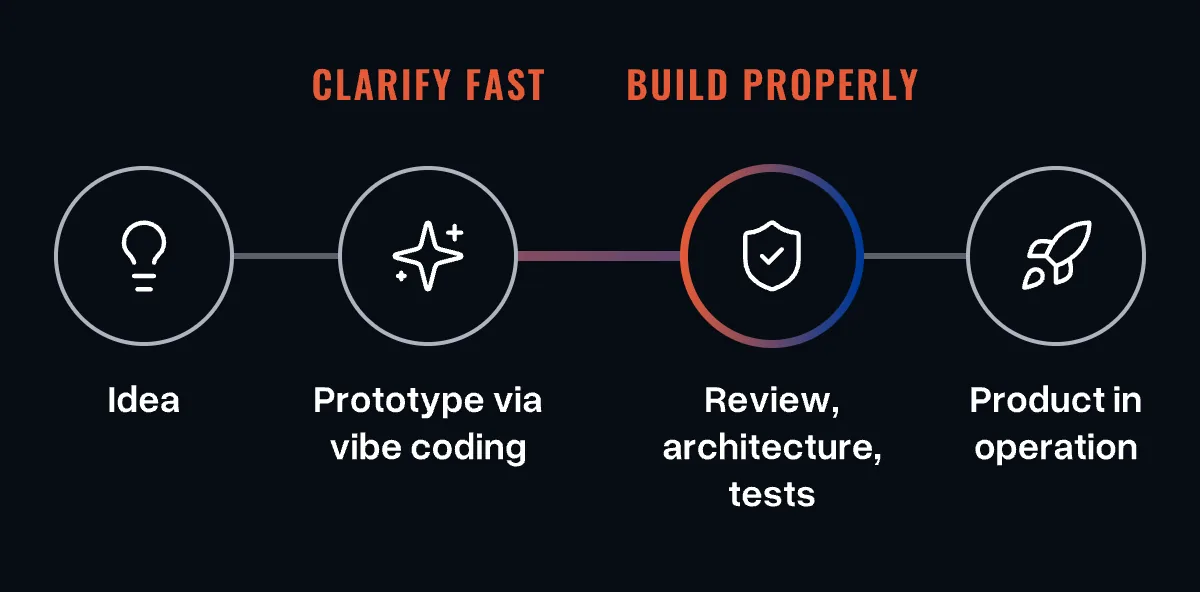
A good path is often both: use vibe coding to clarify quickly what is really needed, and treat the prototype as a specification, not as a foundation. The production version is then built deliberately, with the findings from the prototype.
How Vitec helps you
We use vibe coding exactly where it is strong: for AI prototypes that are clickable within a few days, so you can test your idea with real users. After that we build properly, with architecture, tests and security.
In our own development, AI takes on routine work in every step: checking requirements, drafting designs, writing code and tests. The decisions are made by people, and our developers review every line. This has shortened time to market by 50 % (measured at weguide). Whether your project needs a web application, an app or an AI function, we tell you honestly in a free strategy call whether a prototype is enough for now or what it takes for production. Get in touch.
Conclusion
Vibe coding is not a gimmick and not a replacement for software development. It is the fastest way from an idea to something you can click. For software that customers rely on, it takes more: someone who knows what has to be built, can check whether the AI built it that way, and takes responsibility for it in operation.