

If you are planning an app, one question comes early: build it in-house or work with an agency? Here is what an agency typically delivers, and five honest comparisons to help you decide.
Key takeaways
- A full agency engagement covers consultation, analysis, design, development, QA and support.
- Agencies bring existing expertise and processes, which shortens time to market.
- In-house teams win on communication and permanent availability.
- For most first products, a partner is the lower-risk start; for continuous core development, in-house can pay off.
Want to learn more?
In a free strategy call we answer your questions about cost, technology and process.
Book a callWhat a typical agency engagement includes
Before you compare, it helps to know what you are paying for. A complete app project usually covers these phases:
- Consultation: a good partner starts by understanding what you want to achieve with the app and which challenges stand in the way. This gives the project focus.
- Market and industry analysis: what are others in your industry doing, and which standards must the app meet? This defines technology and interface decisions.
- Design: based on the brief and research, the team turns your idea into a UI/UX design.
- Development: once the design meets the functional and technical requirements, the backend is set up and the app is built with suitable technology.
- Quality assurance: unit tests run during development; a full end-to-end test follows once the app is complete, with developers and testers fixing issues together.
- Support after launch: live apps need fixes and updates. A professional contract defines how long support is included.
Agency vs. in-house: five comparisons
1. Expertise vs. learning curve
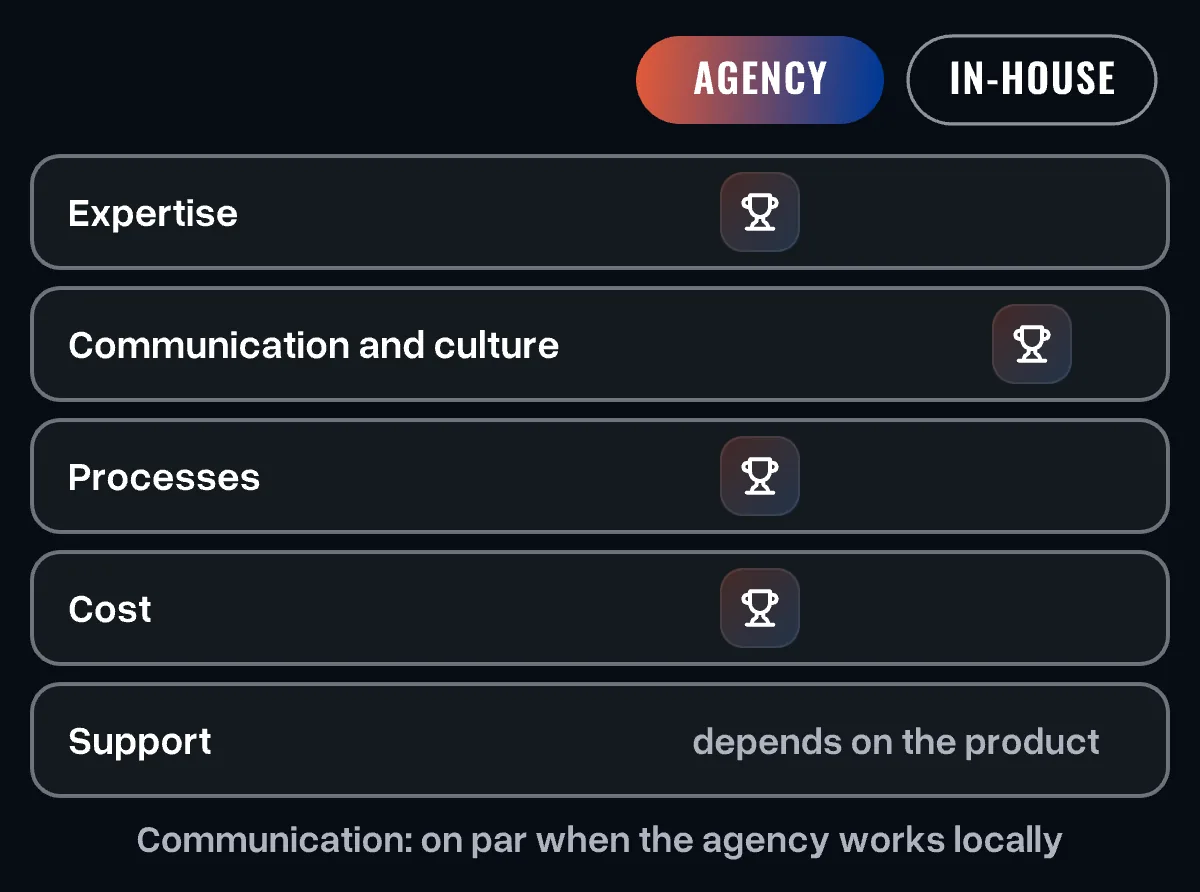
An agency brings a team that already knows the relevant technologies and industry standards, which usually means fewer detours. An in-house team first has to build that knowledge and learn to work together, which takes time.
Advantage: agency.
2. Communication and culture
An in-house team shares language, culture and location, and transparency comes naturally. With an external team, especially one far away, alignment can take effort at the start. A partner in your region, with local contacts, closes much of that gap.
Advantage: in-house, unless your partner works locally.
3. Established processes vs. building them
An agency has its development processes in place, which shortens time to market. An in-house team first has to define processes, get tools and solve issues as they come up, which extends every phase.
Advantage: agency.
4. Cost
An agency spreads tools, know-how and processes across many projects, so the cost of your app reflects the work rather than the setup. In-house, missing experience can lead to rework and rising costs.
Advantage: agency, for most first products.
5. Contracted support vs. permanent team
An agency supports your app within the agreed contract and keeps it up to date. An in-house team is always available, but a permanent team usually costs more than contracted support.
Advantage: depends on how much ongoing development your product needs.
Making the decision
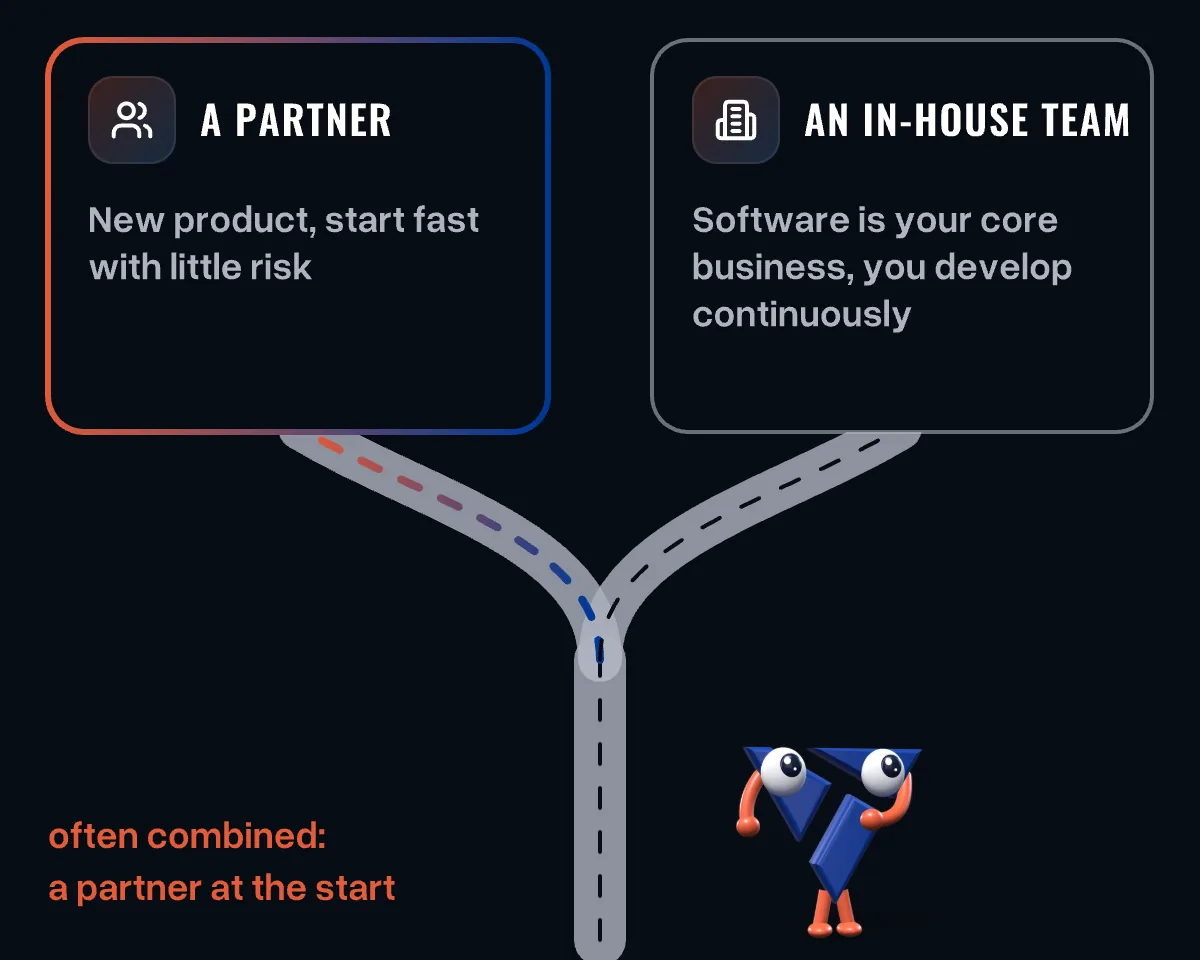
There is no universal answer. If your product is new and you need to move fast with low risk, a partner who owns the outcome is often the better start. If software is your core business and you develop continuously, an in-house team can pay off - often combined with a partner in the early phase.
Still weighing it up? Look at how we have worked with other companies or talk to us - we will help you make the decision on facts.