

A minimum viable product (MVP) is the fastest honest answer to the question every founder and product owner has: will people actually use this? Instead of building the full product on assumptions, you build the smallest version that real users can work with, and you learn from what they do. This guide explains what an MVP is and what it is not, how to scope it, how MVP development works step by step, how long it takes and what it costs, and how to decide what comes after the launch.
- A minimum viable product is the smallest working version of a product that real users can use, built to learn as much as possible with the least effort.
- A PoC checks technical feasibility, a prototype checks understanding, an MVP checks whether real people use the product on their own.
- Good scope means one user group, one problem and one complete core workflow; manual processes in the background are allowed.
- At the market price of 80 euros per hour without AI, a small MVP costs around EUR 12,800 (about 4 weeks), an MVP as a customer app for iOS and Android around EUR 57,600 (about 3-4 months).
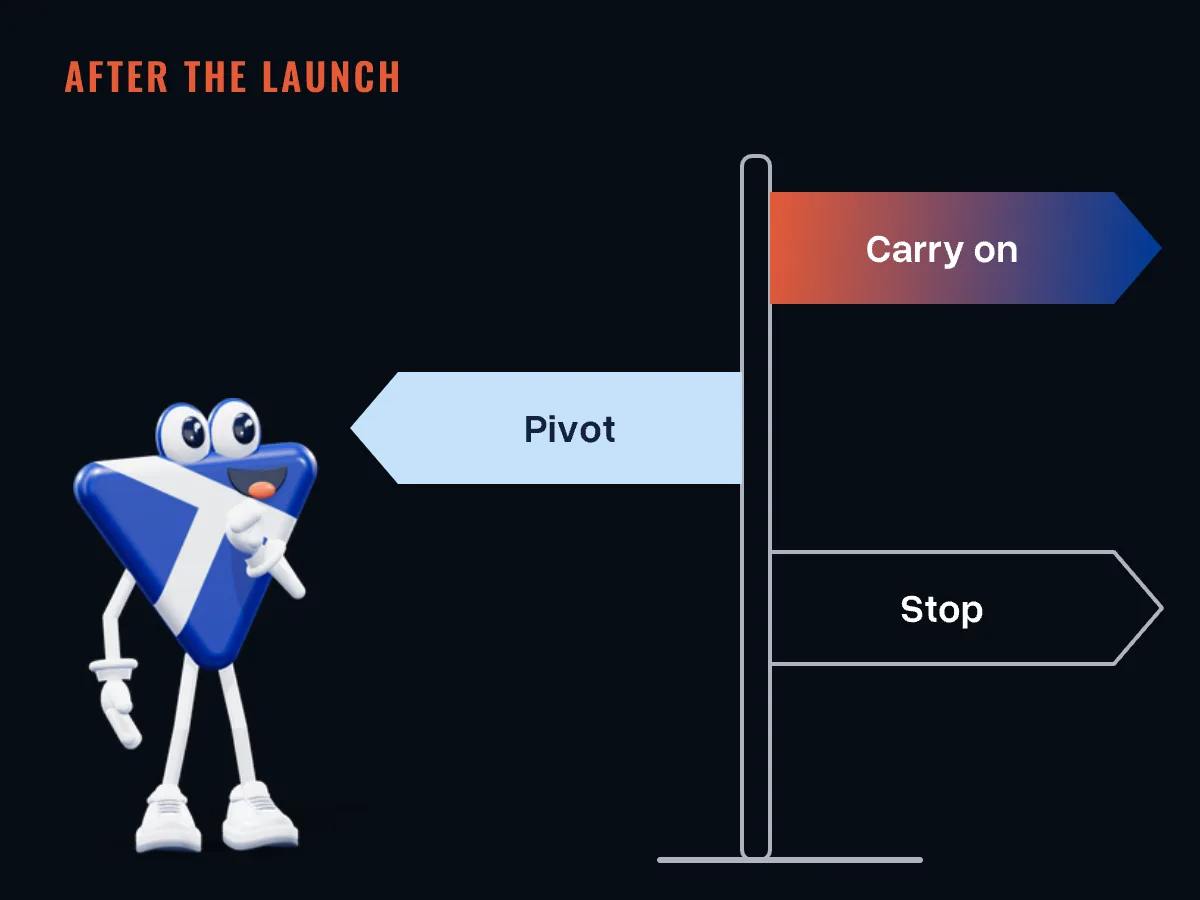
- Define the success metric before the launch, then decide based on data whether to continue, change course or stop.
Want to learn more?
In a free strategy call we answer your questions about cost, technology and process.
Book a callWhat is a minimum viable product?
The term became widely known through Eric Ries. In his 2009 definition, an MVP is the version of a new product that lets a team learn as much as possible about its customers with the least possible effort. Two words carry the weight: minimum, because every feature that does not help you learn costs time and money, and viable, because real people must be able to use it to solve a real problem.
An MVP is therefore not a technical experiment and not a slide deck. It is a working product with a narrow scope: one user group, one core problem, one main workflow from start to finish. Everything else waits until usage shows that it is needed.
MVP, prototype, proof of concept: the difference
The three terms are often mixed up, yet they answer different questions. Knowing which question you need answered first saves a lot of budget.
-
Proof of concept (PoC)
- The question it answers
- Is it technically possible? For example, can the AI read our documents reliably, or can the machine data be accessed?
- What it looks like
- A small technical experiment, often without a real user interface
- Who uses it
- The project team
-
Prototype
- The question it answers
- Do users understand the solution and want it?
- What it looks like
- A clickable design, often without a backend, tested in conversations with users
- Who uses it
- Test users in guided sessions
-
Minimum viable product
- The question it answers
- Do real people use it on their own, come back and perhaps pay?
- What it looks like
- A working product with one complete core workflow, live with real data
- Who uses it
- Your first real customers
Not every product needs all three. If the technology is proven, you can skip the PoC; if the workflow is simple, a short prototype test may be enough. What you should not skip is the question the MVP answers: whether real users use the product without you sitting next to them.
How to scope your MVP
Scope is where most MVPs succeed or fail. The goal is a scope small enough for a fast launch and complete enough to deliver real value. These steps help:
- Name one user group: not 'small businesses', but for example 'the office manager of a craft business who plans appointments by phone'.
- Describe the problem in one sentence: what does this person lose today, in time, money or nerves?
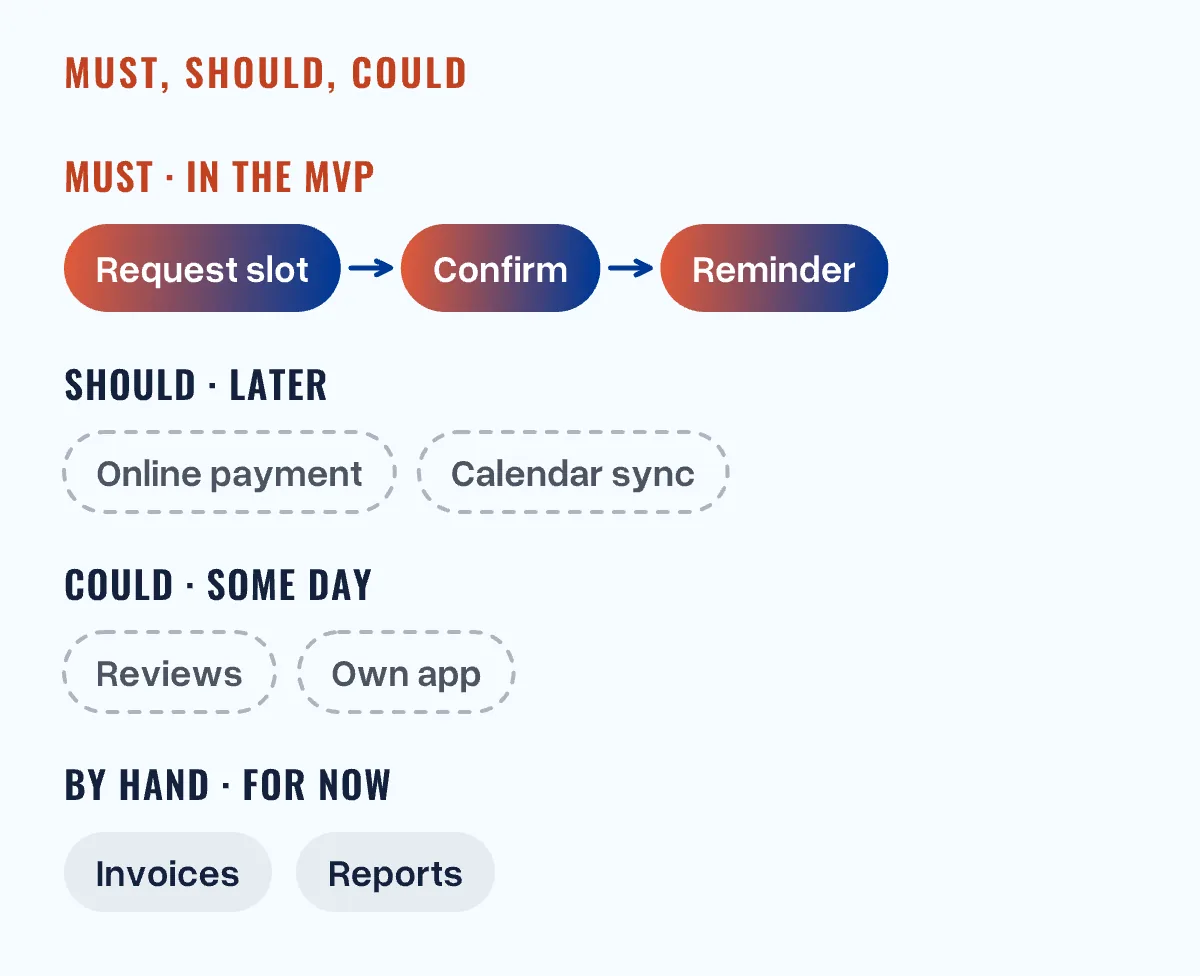
- Choose the one workflow that solves it: from the first step to the result, for example 'request an appointment, confirm it, get a reminder'.
- Sort everything else: must have for this workflow, should have later, could have someday. Only the first group goes into the MVP.
- Decide what may stay manual: invoices, onboarding or reports can be done by hand at first. Automate what users touch, not what you can handle yourself for the first weeks.
- Define success before you build: for example, how many users complete the workflow, how many come back after a week, how many pay.
AI is part of more and more products: according to the German Startup Monitor 2026, artificial intelligence is now at the centre of the product for 53.3 % of the startups surveyed, up from 45.1 % a year earlier. If AI is your core, test that part first with real data, ideally as a small proof of concept, before you build the rest of the product around it.
MVP development step by step
A typical MVP project runs through six steps. The order matters more than the exact length of each step:
- Discovery: goals, users, scope and the success metric are agreed, and the technical approach is chosen. The result is a prioritised list, not a 50-page specification.
- Prototype and test: the core workflow as a clickable design, tested with five to ten people from the target group. Changes here cost hours, not weeks.
- Design: the user interface for exactly the screens the workflow needs, plus the basic visual style.
- Development in sprints: the core workflow first, with a working version to try every one to two weeks.
- Testing and launch: tests on real devices, analytics set up from day one, and a launch to a first, manageable group of users.
- Measure and decide: compare usage with the success metric you defined in step 1 and decide on the next release.
Plan the end-to-end workflow and the admin area from the beginning: someone on your side has to manage users, content and orders from day one. A product that only works with a developer at hand is not yet viable.
How long does an MVP take and what does it cost?
Duration and cost follow from the effort in person-days. The biggest drivers are the number of platforms (web, iOS, Android), integrations with other systems such as payment or an ERP, user roles, and how much of the design is custom. Two typical sizes:
| Scope | Effort | Timeline | Market price without AI |
|---|---|---|---|
| Small MVP: web app with one core feature, login and a simple admin area | approx. 20 person-days | approx. 4 weeks | approx. EUR 12,800 |
| Small customer app as MVP: iOS and Android with backend and admin area | approx. 90 person-days | approx. 3-4 months | approx. EUR 57,600 |
Calculated at the market price of 80 euros per hour without AI (EUR 640 per person-day, the upper end of the usual 60 to 80 euros). With our AI workflows we need around 30 % less time. Work out your own project in our cost calculator.
How these figures are made up, position by position, is shown in our article What does software development cost in 2026?. Six levers that keep the budget small, from the choice of technology to the contract model, are in 6 ways to reduce app and MVP development costs.
Common mistakes in MVP development
We see these mistakes again and again, including when founders come to us with a half-finished project:
- Too many features: every extra feature delays the launch and blurs what you learn. If users do not adopt the product, you no longer know why.
- No success metric: without a target defined in advance, any result can be read as a success.
- Quality below the threshold: crashes and lost data drive away exactly the early users you want to learn from.
- Throwaway technology: an MVP is small, but it should be built so that it can grow. Rebuilding from scratch after a successful launch costs months.
- Building without talking to users: the prototype test is the cheapest moment to find out that the workflow does not fit.
- Forgetting the operation: hosting, app store updates, support and data protection start on launch day, not later.
After the launch: continue, change course or stop?
The MVP has done its job when you can make a decision based on data. Set the thresholds before the launch, so that you are not tempted to interpret the numbers in your favour afterwards. Typical signals and what they mean:
| Signal | What it means | Next step |
|---|---|---|
| Users come back and use the core feature | Problem and solution fit | Continue: prioritise the next feature by usage |
| Lots of interest, little usage | The promise works, the product does not yet | Improve the core workflow, talk to users |
| Usage only with your personal help | Target group or workflow does not fit yet | Change course (pivot): test another group or core feature |
| Hardly any interest despite reach | The problem is not urgent enough | Stop, or redefine the problem |
Stopping is a legitimate result. An MVP that shows a clear no after a few weeks has saved you the budget of a full product. A pivot is just as legitimate: many successful products started with a different target group or a different core feature than the one they are known for today. Slack was first the internal chat tool of a games studio working on the online game Glitch (MIT Technology Review). Instagram began as Burbn, a check-in app with many functions, until the founders cut everything except the camera (The Next Web).
How Vitec supports your MVP
We are a software development partner from Stuttgart and have been a partner to more than ten startups. For an MVP we start where most of the risk lies: with the product decisions. In discovery we work out scope, priorities and the technical direction with you, and a focused prototype checks the direction before the effort grows. We then design, build and run the MVP as one team, and stay responsible once real users arrive.
We only take on a few products each year, so a senior team works on yours, with special conditions for startups. The source code always belongs to you, and with AI in our workflows we shorten the time to market by up to 50 %. More on our page for startups, where you can also book a free strategy call, and on product strategy and discovery.
Conclusion
A minimum viable product is not about building less, but about learning faster. Choose one user group, one problem and one workflow, define success before you build, and keep the quality high enough that users trust the product. Then let real usage decide: continue, change course or stop. That is how an MVP turns an idea into a product decision you can stand behind.